
A RANDOM WALK
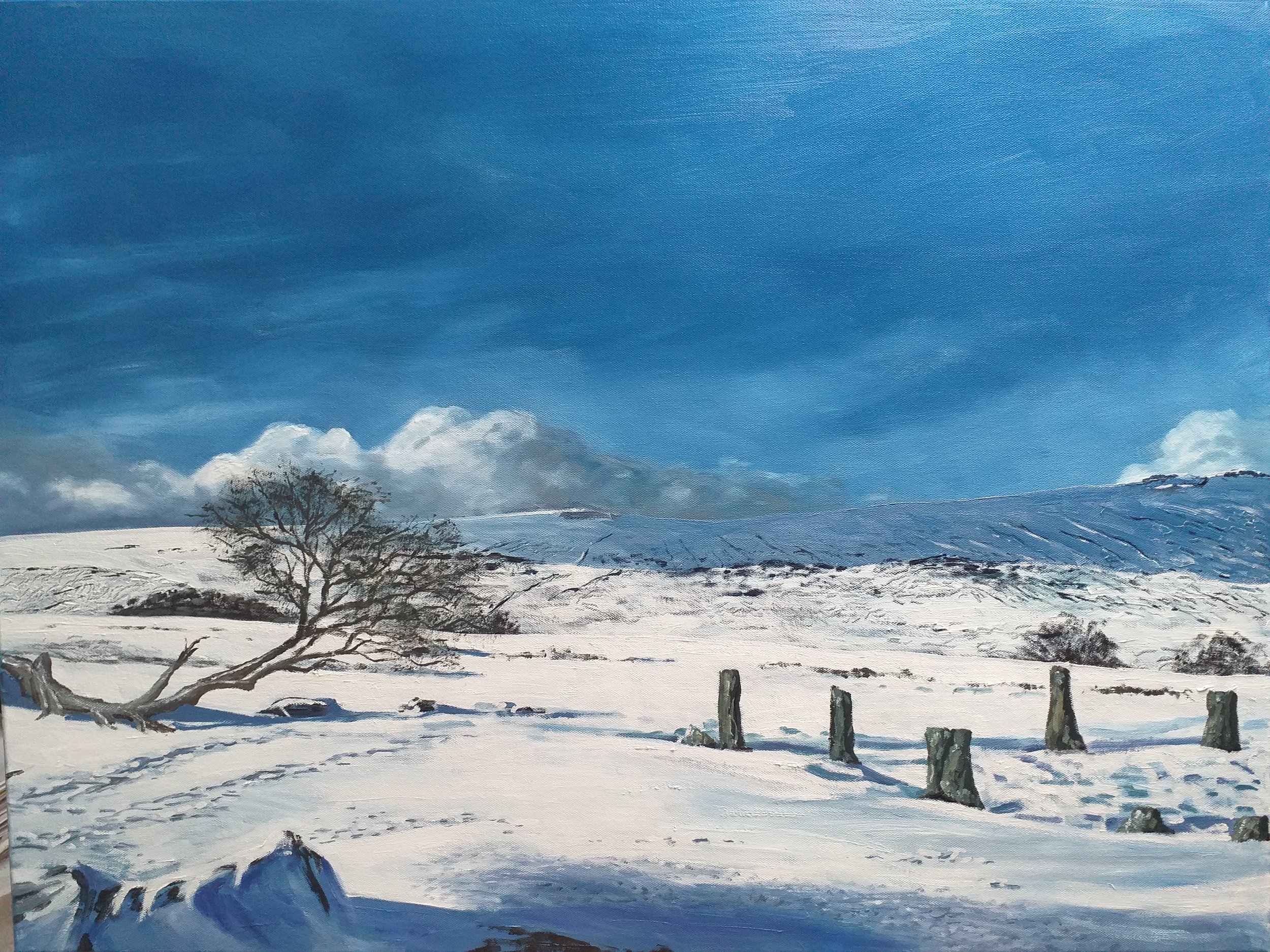
Following a career in finance, I began painting in 2019, and it has become an increasing focus in my life. A self-taught studio painter of mostly, but not exclusively, landscapes, I nevertheless paint primarily from pencil and watercolour sketches “en plein air”. But I also supplement these with photographs. Before the increasing demands of career and family made a very time-consuming pastime more difficult, I did a lot of landscape photography – much carries over, light and shade, tone, form and composition. The camera also helps train the eye to find an “image” within the wider context. But even the best camera will compromise on light and colour. So the period of intense observation and often annotation, even if sometimes only fairly brief, is for me a vital part of the final painting. The memory of “being there”, perhaps the way the wind is moving the clouds or light plays on foliage, is as much a part of the final result as trying to capture it on paper and film. If a viewer can sense some of that, I have succeeded. If not, I have failed. This exhibition is the result of some three years of work – some planned, such as trips to Iona and Greece and some more accidental. Hence, the title “A Random Walk”. Now the paintings are on the wall – and the jury is out…
Exhibition Foreword
By Hester Baldwin, Managing Director
Long before David Stogdale became known as a painter, he was an amateur photographer.
During his years living in Bahrain in his mid-twenties, the camera became more than a means of recording where he had been. It became a way of understanding why certain moments deserved to be remembered at all. Every photograph required a decision: what to include, what to leave behind, where to stand and when to press the shutter. Composition ceased to be an artistic exercise and became an act of observation. Why does this particular arrangement of land, light and shadow compel us to stop? What is it about this fleeting moment that asks to be preserved?
It is an intriguing thought that so much of our collective memory depends upon these decisions. Photographs often become the only surviving record that a place appeared as it once did, or that a particular moment ever existed at all. Words can take us remarkably close to an experience. Great writers can evoke the smell of rain on warm earth or the silence that follows snowfall. Yet there remains something elusive, almost spiritual, about standing within a landscape that ultimately resists language. It is perhaps here that painting begins. Not as a substitute for photography, but as its natural successor. Where the photograph records what was seen, painting allows us to communicate what was felt.
That desire to understand rather than merely record runs throughout David’s work, and its origins perhaps lie long before the photography and paintings themselves. He was fortunate to grow up with a mother who studied geography, possessed a deep enthusiasm for geology, and had an infectious curiosity about the natural world. Thanks to her, ordinary family walks became something far richer than simple outings.
Landscapes were never merely backdrops or places to pass through; they were living histories waiting to be read. Hillsides, river valleys and coastlines revealed stories of shifting continents, glaciation, erosion and the immense passage of time. It is hard not to see those formative experiences reflected in David’s approach to painting. They seem to have fostered a lifelong habit of looking beyond the surface, asking not only what we are seeing, but how it came to be and what deeper history lies beneath the visible world.
There is a wonderful observation by the physicist Richard Feynman, who recalled that his own father never taught him what to think, but encouraged him to remain endlessly curious about the world around him. Naming a bird, he argued, was never as important as understanding how it lived. That distinction feels particularly apt here. David’s paintings are born from the same instinctive curiosity. He is not content simply to paint a beautiful valley or a dramatic coastline. He wants to understand the geological forces that formed it, the weather that continues to shape it and the centuries of natural history written into every outcrop and hillside.
hat spirit of enquiry has remained with him throughout his life. His years living in Bahrain only deepened that fascination, offering a landscape where geology reveals itself with extraordinary clarity. Returning to Britain, he brought back a renewed appreciation for the subtle complexities of our own coastlines and moorlands. The folds of Dartmoor, the volcanic landscapes of Iona and the weathered cliffs of Northumberland are not simply picturesque destinations but chapters in a story millions of years in the making.
More recently, time spent painting in Greece has turned that same curiosity towards something less permanent, but no less compelling: light. Working among the olive groves, David repeatedly changed his position, moving around and between the trees until their forms began to reveal themselves. In some ways, it returns us to those early lessons of photography and the importance of deciding where to stand. An olive tree is a wonderfully complicated subject: ancient, twisted and irregular, appearing quite different with each change of viewpoint. By positioning himself throughout the grove, David came to understand not simply the silhouette of the trees, but their weight and structure, the way their branches occupy space and the dappled light that passes through them.
Perhaps most surprising was the discovery of just how many greens existed there. What might initially appear to be a limited Mediterranean palette became, through sustained observation, an extraordinary range of silvery, blue, yellow and deep shadowed greens, constantly altered by the intensity of the Greek sun. These paintings have a palpable warmth. One can almost feel the heat held in the earth and the welcome interruption of shade beneath the branches. As with his coastlines and moorlands, David is not simply describing what an olive grove looks like. He is attempting to convey what it feels like to stand within one.
What strikes me most about this exhibition is that knowledge never overwhelms the paintings. It quietly underpins them. Looking through the collection, one is immediately drawn to the remarkable quality of light. At first glance, the colours may appear unusually saturated, but the longer one spends with the work, the more one realises that David is not embellishing the landscape. Rather, he is reminding us of something we have almost forgotten. Landscapes that remain largely untouched possess a luminosity that can feel almost improbable. Away from the haze of roads, towns and constant intervention, colours acquire an extraordinary clarity. The sea seems deeper, the grasses richer and the sky impossibly expansive. His paintings capture that rare sensation of standing somewhere so unspoilt that the world appears newly made.
It is a great honour to present David Stogdale’s second solo exhibition at Green & Stone. This exhibition is an invitation to travel; to stand beneath vast skies, to walk ancient coastlines, to find shade beneath olive trees and to experience landscapes shaped over billions of years. My hope is that these works encourage you not only to admire the places David has painted, but one day to visit them yourself. Few artists remind us so eloquently that the greatest journeys begin simply by learning how to look.
Hester Baldwin, Managing Director, 2026