RECENT WORK
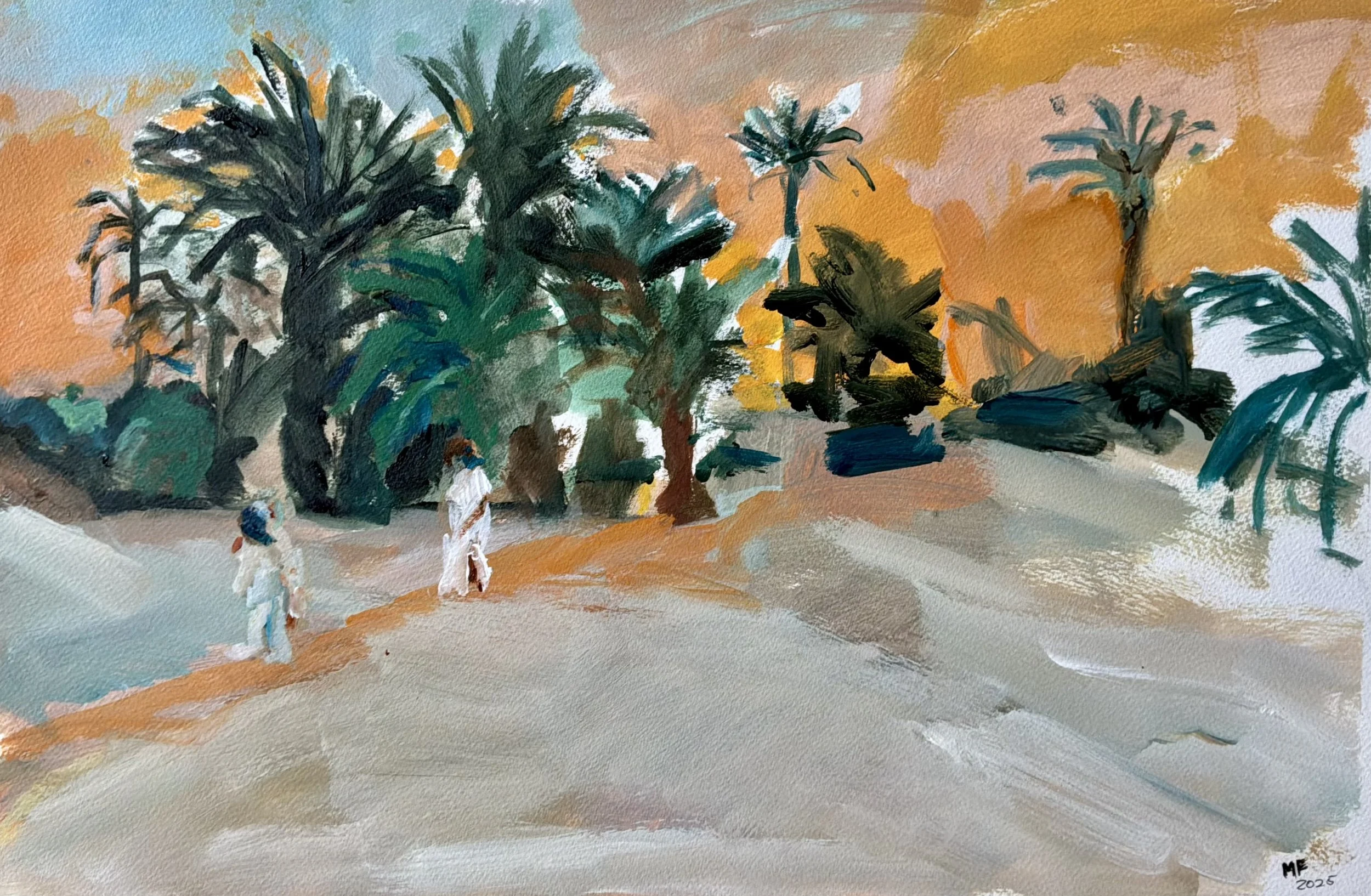
Mehri Foda, Friends in Siwa
-
Mehri Foda was born in Cairo in 1950.
In 1994, she studied under portrait and figurative painter Aris Raissis while attending a figure painting course at the Slade School of Fine Art. In 1999, meeting the renowned artist and teacher Bobby Gill marked a turning point in her practice, leading her towards a more abstract visual language inspired by artists including Giorgio Morandi, Lee Krasner, Ivon Hitchens, and Henri Matisse.
Foda’s first solo exhibition was held at the Gezira Art Center in 2019. Most recently, she exhibited a solo show at the Gallery at Green & Stone in 2025. She works across oils, pastel, gouache, acrylic, mixed media, and collage.
-
Mehri Foda’s recent works reveal an artist working with a rare and deeply instinctive confidence. Drawing inspiration from across Europe and the Middle East, her paintings absorb the atmosphere, architecture, colour and visual memory of these landscapes, transforming them into works that feel both intimate and timeless. Across still lifes, figurative scenes and architectural motifs, colour and shape are not merely compositional devices but the very language through which feeling, memory and rhythm are expressed. There is, of course, considerable technical accomplishment underpinning these paintings, years of observation, discipline and refinement, yet what distinguishes Mehri’s work is something far less teachable: an innate sensitivity to balance, tone and form. Her understanding of colour feels intuitive rather than calculated, guided as much by instinct as by intellect.
Particularly striking are her paintings of Siwa, where light itself seems to become a subject. The warmth of sunlit walls, the softness of shifting shadows and the quiet intensity of colour evoke not only a place, but a state of calm contemplation. There is a profound sense of peace within these works, as though history lingers gently in the surfaces and spaces she paints. Mehri captures the magic of Siwa through atmosphere as much as image; its layered history, ancient rhythms and luminous beauty emerge through subtle tonal relationships and carefully balanced compositions. The paintings carry the sensation of memory held within architecture, where colour and light preserve the emotional weight of place.
In these paintings, objects dissolve and reassemble through colour relationships and spatial tension. A doorway becomes not simply an entrance, but a threshold between light and shadow, geometry and atmosphere. Still life arrangements pulse with an unexpected vitality, their forms simplified yet emotionally resonant.
Figures emerge through gesture and movement rather than rigid definition, allowing the paintings to retain a sense of immediacy and freedom. Throughout the exhibition, Mehri demonstrates a fearless willingness to trust the painting itself, to allow colour to lead, to let shapes converse naturally across the surface.
There are echoes of modernist sensibilities within the work; one senses an affinity with artists who understood that structure and emotion are inseparable, yet Mehri’s voice remains wholly her own. Her paintings possess a lyrical quality that resists overstatement. Bold passages of colour are counterbalanced by moments of restraint; abstraction and representation coexist without conflict. The result is work that feels both deeply personal and universally accessible.
What is particularly striking is the generosity of spirit within these compositions. Mehri paints with conviction, but never with self-consciousness. There is an honesty to the work that invites the viewer to slow down and look carefully: to notice the cadence of a line, the tension between adjacent colours, the quiet intelligence of a seemingly simple arrangement. These are paintings that reveal themselves gradually, rewarding prolonged attention.
We are enormously proud to present Mehri Foda’s second exhibition at Green & Stone. This collection is from an artist who continues to evolve while remaining utterly true to her instinctive visual language. In an age so often dominated by excess explanation, Mehri reminds us that painting, at its very best, can communicate through feeling alone.
Hester Baldwin, Managing Director, 2026