
Michelle Maddox: There’s No Place Like Home (Copy)
Ahead of her upcoming exhibition There’s No Place Like Home, we spoke to painter Michelle Maddox about her practice, her interest in home and belonging, and the role of observation in her work.
Working in oil, Michelle paints familiar objects, interiors and landscapes, using colour, memory and atmosphere to explore what home means to her. Her paintings begin with observation, but rather than simply recreating what she sees, she allows forms and colours to soften and shift, creating a sense of familiarity and quiet reflection.
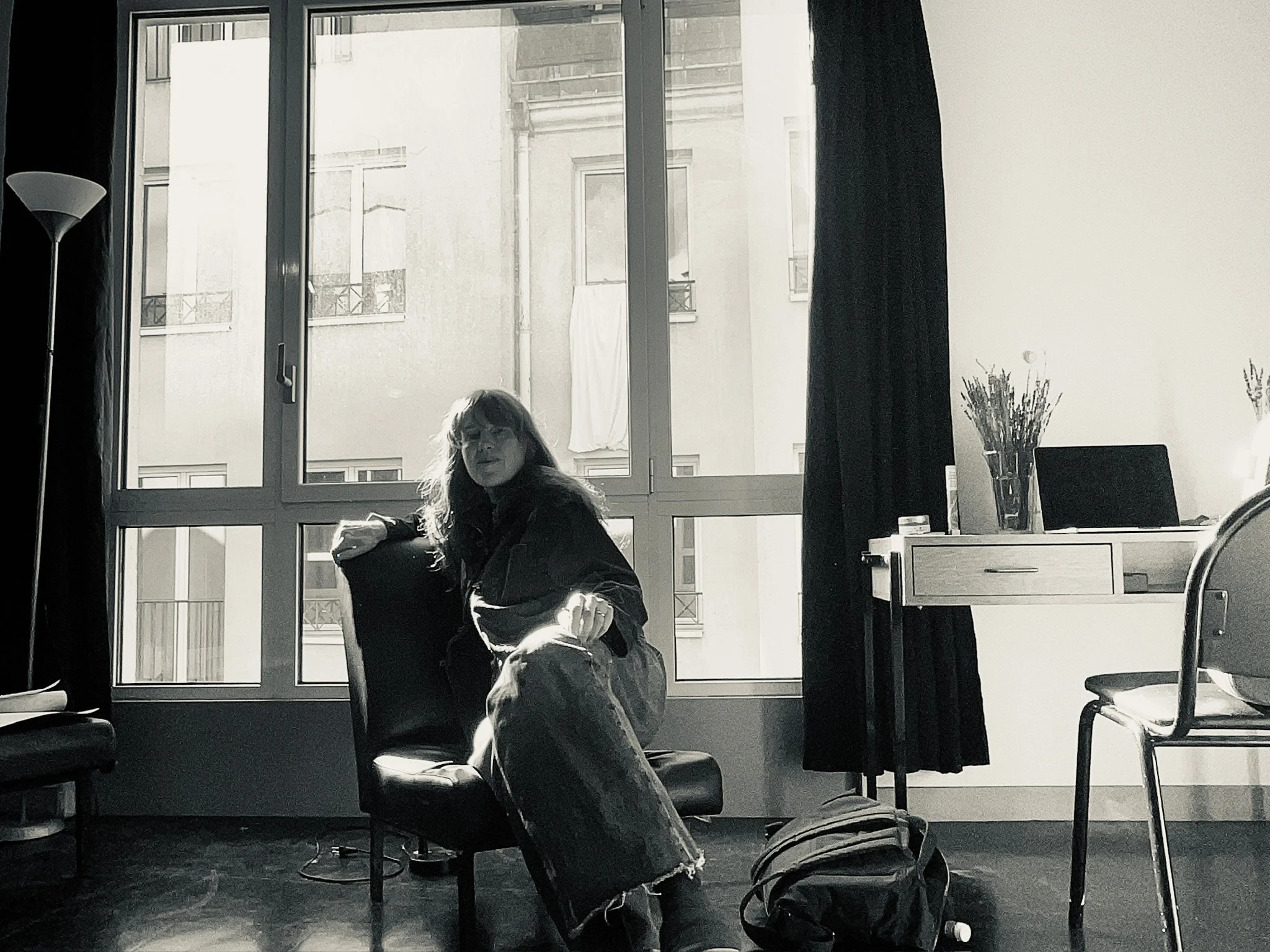
Michelle in her studio
Your exhibition is titled There’s No Place Like Home. What does home mean to you, and how has your own search for a sense of place shaped this body of work?
So the title doesn’t necessarily mean a physical place, but is more about an emotional connection. Recently I have been researching my family history through place, memory and old documents for a project here in Switzerland which focuses on having mixed cultural heritage. I’ve spent much of my life moving between Switzerland and England and travelling the world, perhaps in search of a sense of belonging and somewhere I could truly call home. Although each place has a pull I am usually left feeling like I don’t completely belong anywhere. I have come to believe that my sense of home lay in my practice, through the deep observation of whatever subject resonates. It’s in the focus and intepreting of these images that I find a sense of belonging. My practice is my anchor and if I can paint I feel settled.
The title is also a quote from the first film I ever saw as a child – The Wizard of Oz - which still draws me in today evoking memories of my childhood and gives me that same warm feeling inside.. like home should.
The title can be interpreted in different ways and I think over a lifetime the meaning of home changes through who we meet and through our own self discovery.
You use observation as the starting point for your paintings, but allow meaning to emerge through the process. Can you tell us a little about what happens between first seeing something and the finished painting?
I do like to have a starting point and that can be anything from everyday objects to the cat lying on a bed, or a single tree on a hill, I I guess anything that resonates, and then I begin to translate this into a painting. But I don’t just try to copy what I see in a realistic manner, I am looking for something poetic. I might omit certain details and invent shapes and colours so I think that’s where the meaning comes into it. Its about searching for the essence and the harmony in the image. Often the painting is leading me, and certain parts work better than others and so I follow that. I try not to force it.
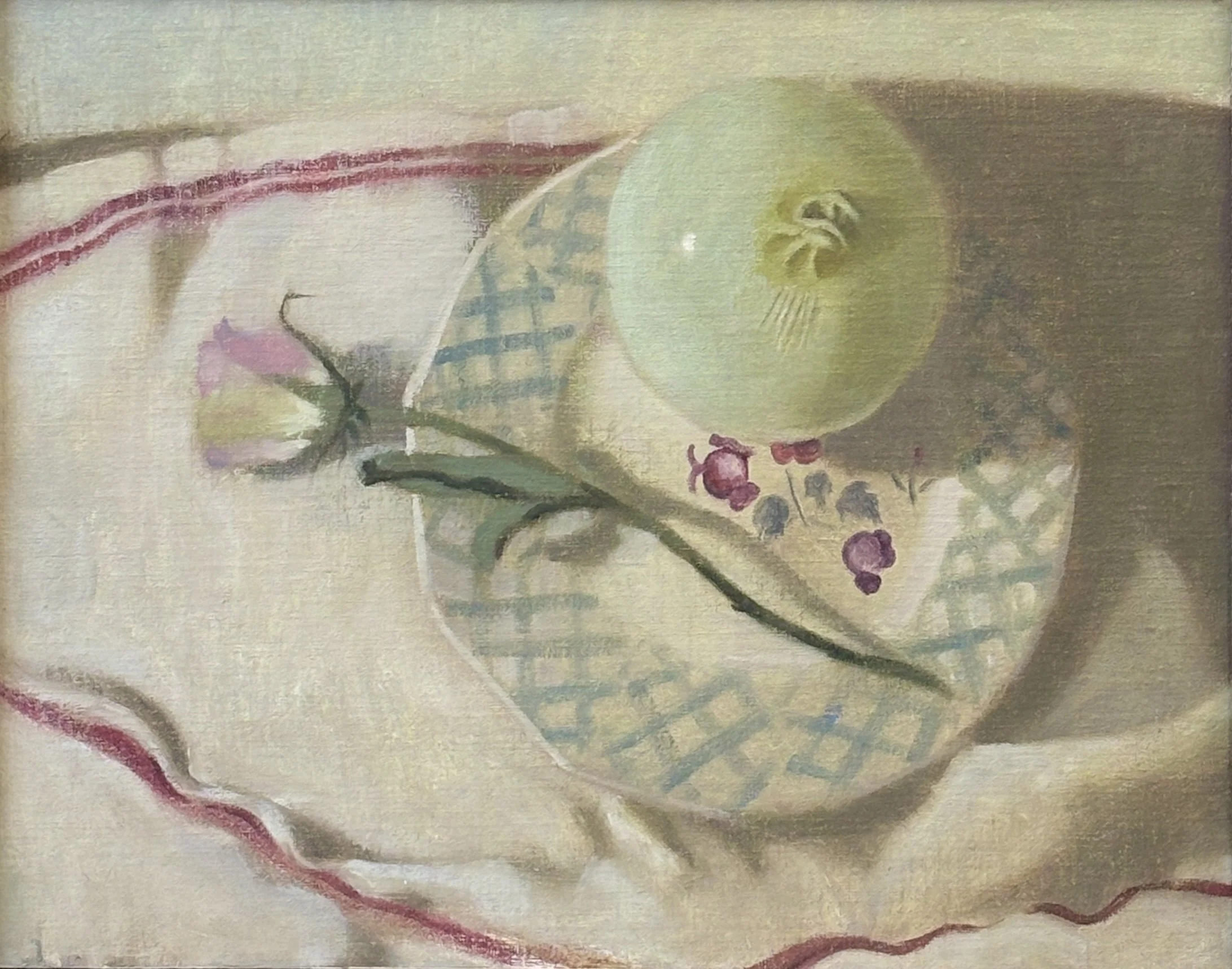
Still Life with Plate, Balloon and Rose, Michelle Maddox
You often paint familiar, everyday objects. What is it about these ordinary things that makes them interesting to you as a painter?
I don't think I consciously set out to paint everyday objects. What has always fascinated me is really looking. I'm interested in the meeting of colours, shapes and light, and in finding something that resonates emotionally through purely visual means.
But perhaps I do enjoy finding something poetic in the unspectacular objects. If we look carefully, we can find beauty in the most unexpected places. For all the years at home bringing up my children I think I noticed the more banal things...or the little daily rituals. Observing the everyday helps you to slow down in life too and painting them I find really grounds me.
You’ve described particular objects and colours as evoking a sense of familiarity. Are there certain objects, colours or places that immediately bring back memories for you?
I’ve collected antiques, textiles and beautiful, fascinating objects for years, perhaps partly in search of something familiar to anchor me. But with all the travelling I’ve done, I’ve realised that objects don’t necessarily carry my memories, smells do. The scent of a cigar or a particular perfume can instantly bring back powerful memories and emotions.
How important is colour? Do you choose your palette intuitively, or is it something you carefully work out?
Colour and tone are the most important parts of my practice. I start with conscious decision-making but then as I get in the flow I rely on intuition. It has been important to learn how colours work (I still have a lot to learn). However I also experiment directly on the canvas and see what happens. I like surprises whether good or bad. I don’t want too much predictability.
I use a split primary palette and then add some special combinations.
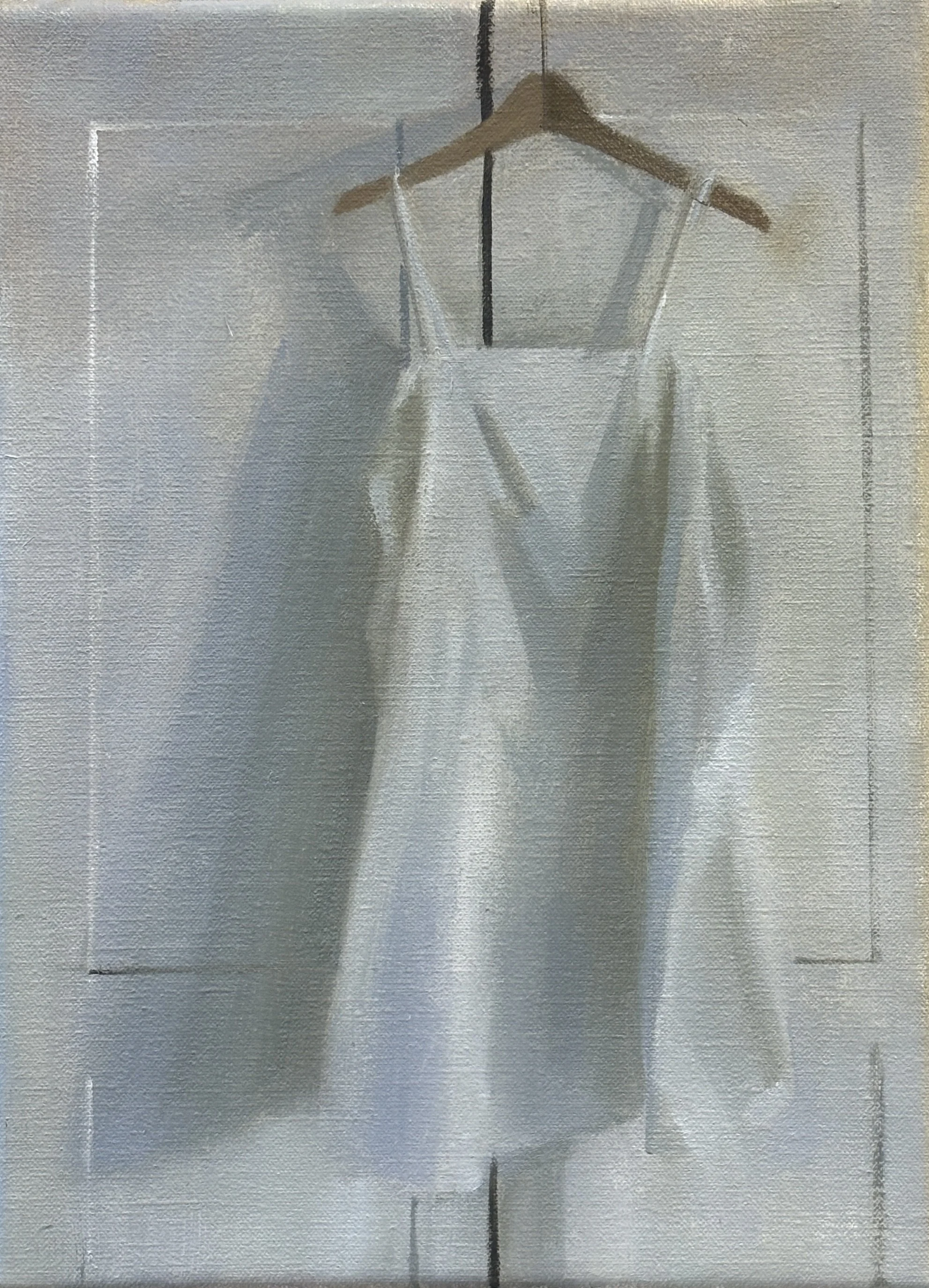
Nightdress, Michelle Maddox
Is there an everyday object that you’re slightly obsessed with painting?
There are a few that keep re-appearing in paintings, such as the antique linen teacloths and certain handmade ceramics, also a particular French plate from the 1940s. They all offer different things. The linen can be used as a background or a feature and can create some nice folds, the plate has a decorative pattern to add visual interest and the handmade porcelain pot I often use to balance composition.. it was also made by my ceramicist friend Martina Williams so that adds personal meaning.
What’s the strangest or most unexpected object that has inspired a painting?
Probably an antique wooden cog from a Dutch windmill which I bought from an antiques fair in Suffolk. The chunky teeth on it created some lovely shadows!
Do you ever see something when you’re out and immediately think, I need to paint that?
Yes!! All the time. My phone is a mess as its full of weird images, either for inspiration or to remember to revisit and paint it. I have ADHD which was not easy in a normal school environment but as an artist I see it as a huge plus as I am bursting with ideas - the only problem is holding on to the ideas and realising them before the next one invades my mind.
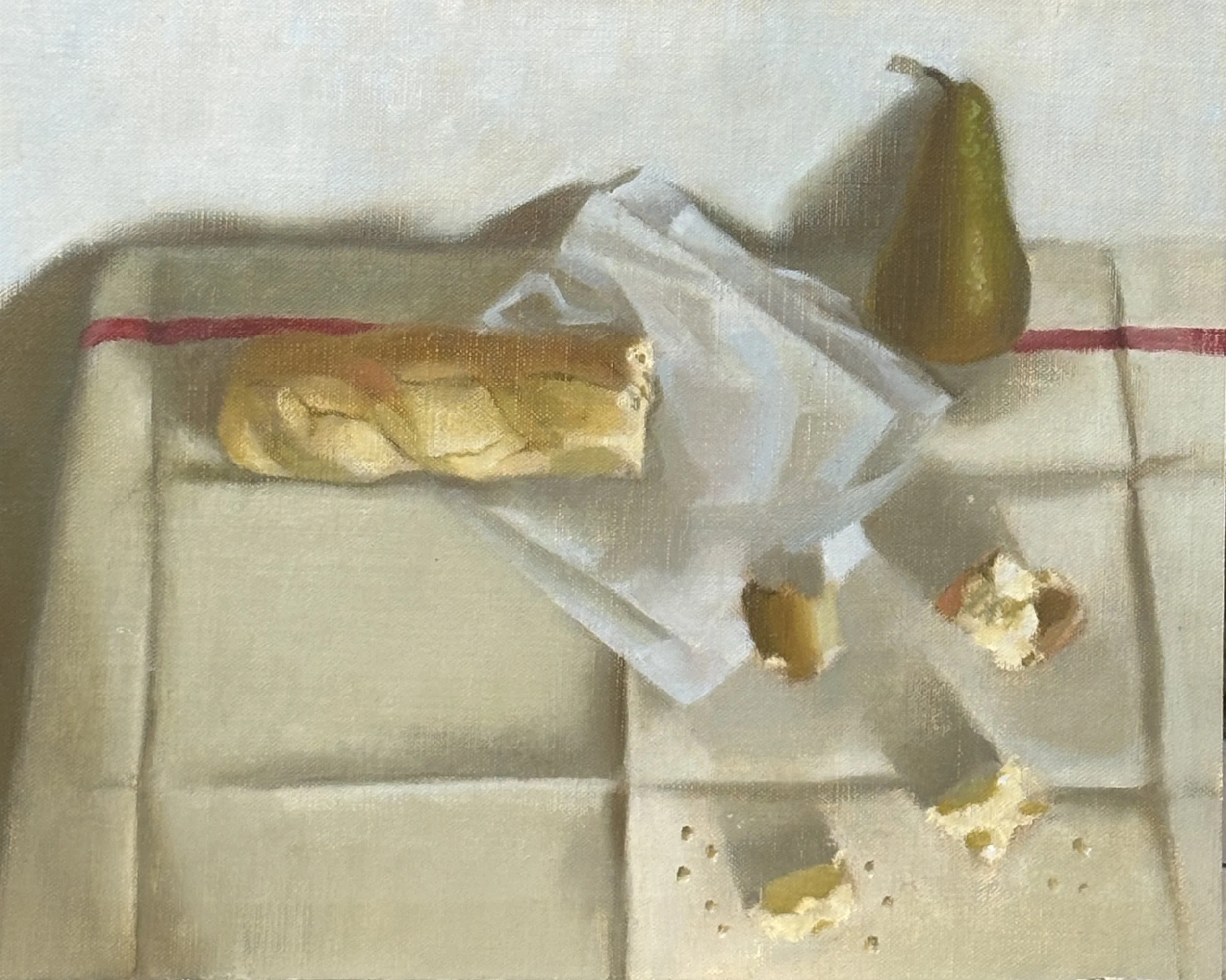
Still Life with Baguette, Michelle Maddox
What are your favourite art materials?
I love Michael Hardings and Old Holland paints. A specific colour I have discovered which is now an unsusual staple is Michael Hardings Bright Green Lake and Violet Grey from Old Holland. I like Claessens 13 or 66 linen which is an oil primed Belgian linen, but also love to prime my own raw linen with Lascaux gesso as you can get a more rustic uneven look. I have a wide selection of Green & Stone brushes.
You’re going to a desert island, what art materials are you bringing with you?
I would take some Green and Stone hog brushes, a few smaller synthetic brushes, a split primary palette of Michael Hardings paints, Arches oil paper and a mix of Claessens linen and raw French linen with a pot of Lascaux gesso. For cleaning my brushes I use different non toxic brands like Sennelier and Chelsea Studio... trying to consider the environment. I would also love a watercolour pad or some Khadi paper and some paints to capture quick landscapes... completely inspired by my recent trip to Cornwall!
What does a typical day in the studio look like?
At the moment I am painting everyday and my hands are suffering so I start the day applying hand cream and then apply Raths PR 88 which is a cream that acts as a glove. I can’t wear real gloves. They feel strange.
I then spend 10 mins or so just looking at what needs attention. It is easiest to get in the flow of work if I am halfway through a painting. Beginning anew would mean a morning of playing with set ups and compositions and needs more decision making. Finishing a painting is the hardest thing.
When working towards an exhibition I tend to start lots of canvases and then feel I am on a good thing but end up with loads of almost finished works which need tweaking and I now think that this stage of the process takes the longest. The time is not taken up with painting but more with really looking and optimising. Having said that, on the odd occasion I paint a painting in one sitting in quite a painterly style. Its never intentional but it just feels finished in one go. For example the ‘Unmade Bed’ painting or ‘The Bed’ painting.
So my routine may be setup a still life, prepare canvas, make an underpainting, or mixing colours ready for continuing a painting. I have breaks every 50 minutes and walk away from my work. This has proved to be more and more important. Fresh eyes are essential to see where it’s not working.
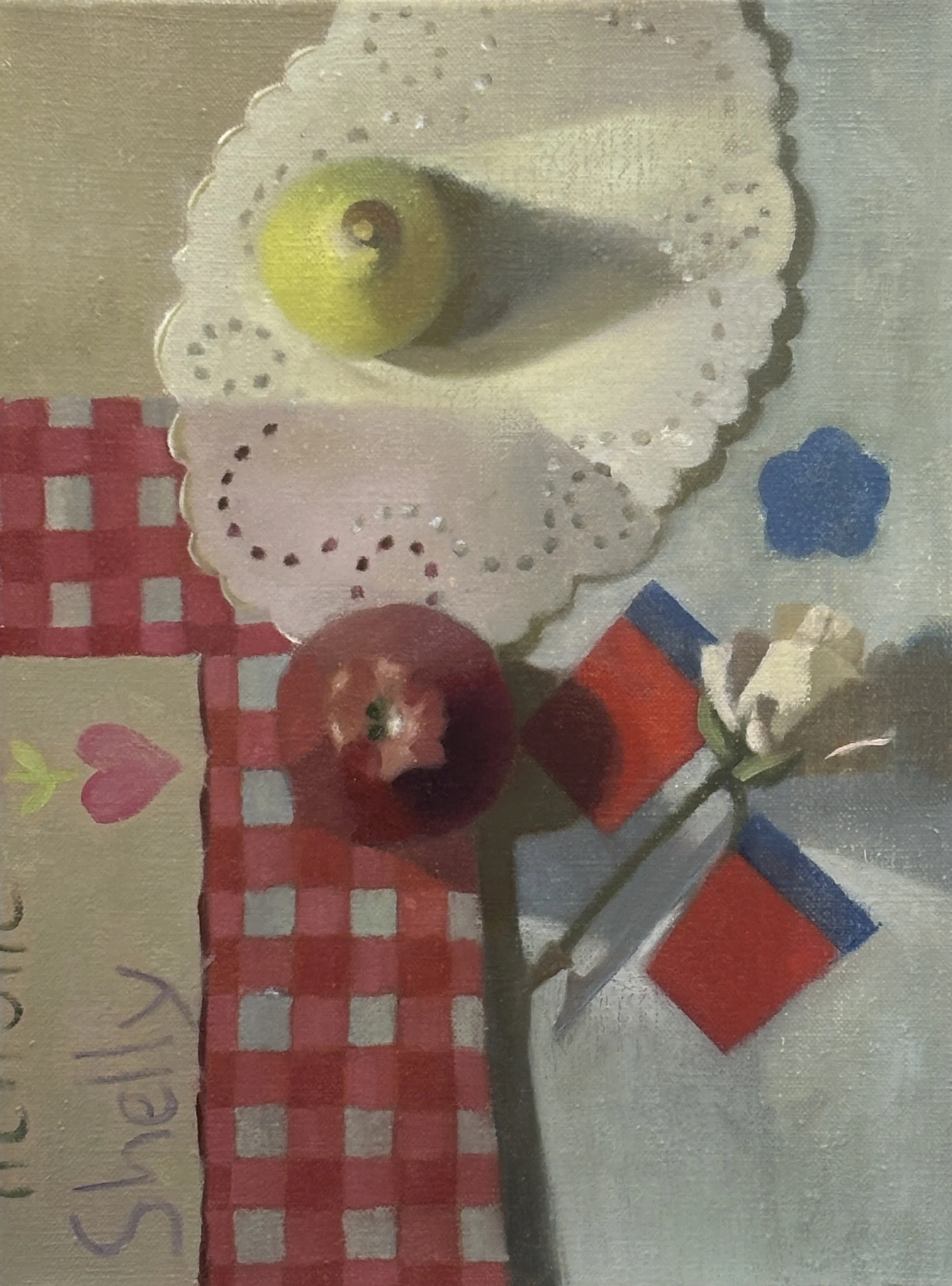
Childs Gift, Michelle Maddox
If you could paint one place purely from memory, rather than observation, where would you choose?
I think it would have to be an English landscape..perhaps of flat open fields like the Fens or somewhere in Suffolk or of the Sussex Downs. Although I live in Switzerland and admire the mountains I am not a fan as valleys make me feel claustrophobic. I like wide open spaces and huge skies and to be able to see far into the distance.
If you could take one painting from There’s No Place Like Home home with you, which would it be?
Maybe Mirtle and Lucy on the Bed... it was a breakthrough painting for me personally as it has a sense of abstracted figuration. I like that it doesn’t rely on a lot of modelling or detail and I enjoyed adding texture rather than scraping back which I often do. But I also like the playfulness of Imagined Seascape.
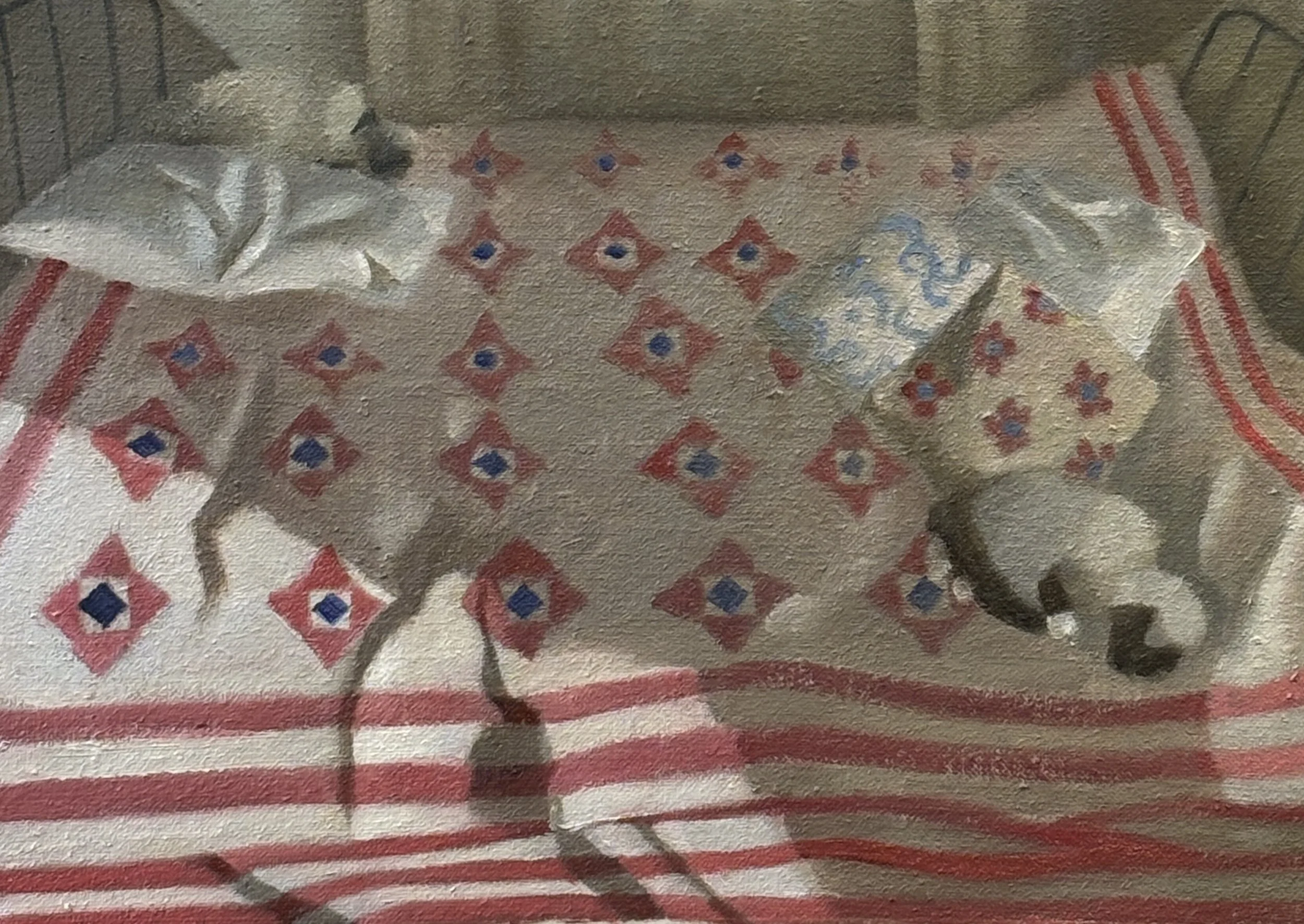
Cats on the Bed, Michelle Maddox
There’s No Place Like Home, Michelle Maddox’s first solo show at The Gallery at Green & Stone will be on from 19 - 31 October.