An interview with Russell Herron
Russell Herron (b. 1967, Essex) is a UK based artist whose practice centres on drawings of faces, made from pieces of discarded cardboard. Working from cardboard that he cuts, tears and shapes into imagined faces, Russell carefully translates these forms.
Over the years, his work has been selected for exhibitions including the Royal Academy Summer Exhibition, the Trinity Buoy Wharf Drawing Prize, the ING Discerning Eye and the Derwent Art Prize. His drawings have also been shown at London Art Fair and internationally in Shanghai, Singapore, Hong Kong and Berlin.
Ahead of his upcoming exhibition at Green & Stone, we caught up with Russell to talk about his cardboard faces, the process behind making them, and what continues to draw him to this unusual material.
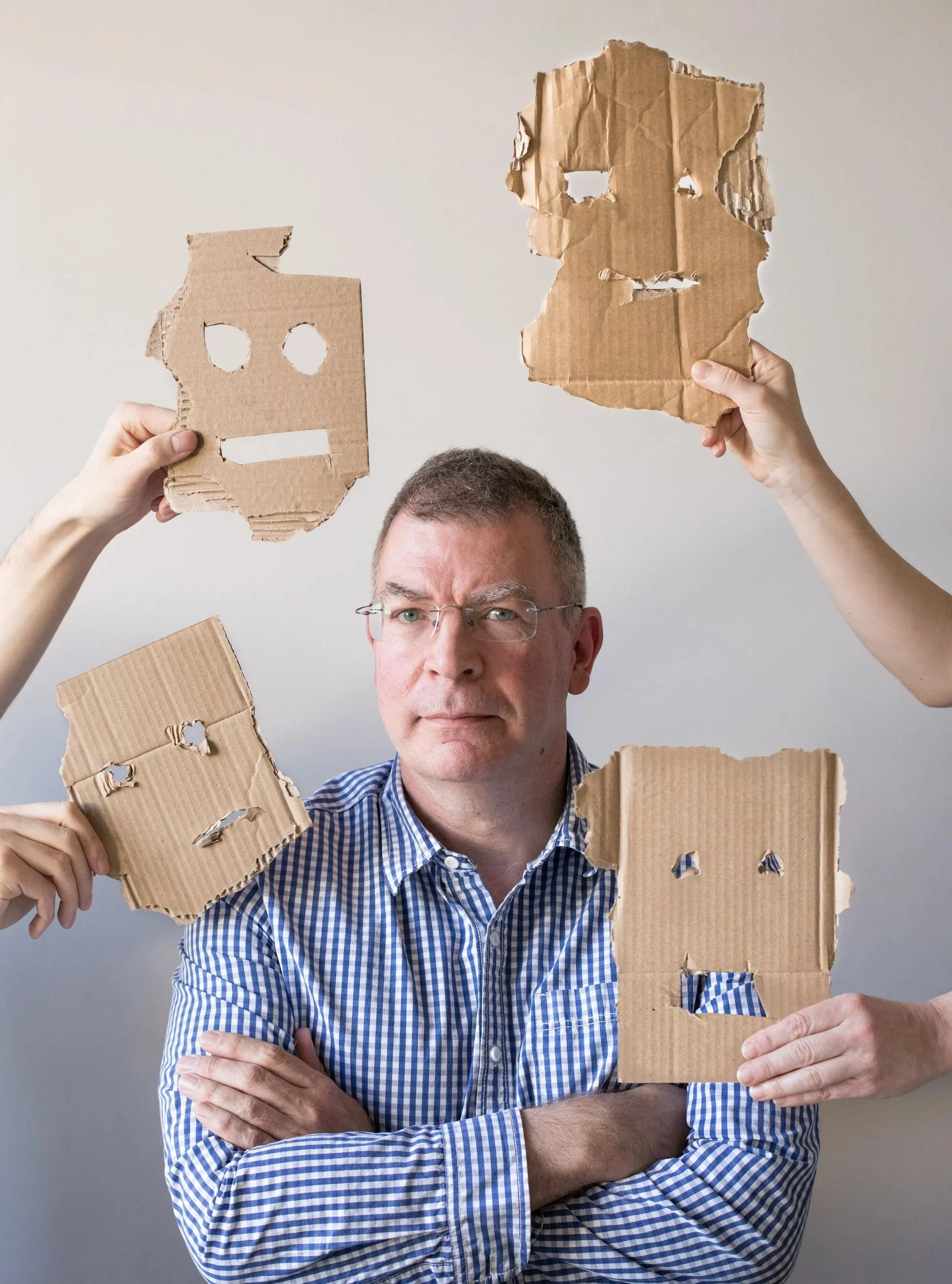
Portrait of Russell
How did your cardboard portraits begin? Was there a particular moment when you first looked at a piece of cardboard and thought, that looks like a face?
In 2017 I started a project making drawings of artists I knew. When a drawing was completed, I asked the artist to nominate another artist they knew for me to produce another drawing. I was building a map of an artworld and charting the organic connections between us all.
In 2018 I took part in a local open studios event. I’d never done one before and, with only some very large portraits of artists, I figured I ought to have some smaller works to try and sell. I drew a handful of things; among them an empty water glass, a flower, and a piece of ripped cardboard. The cardboard drawing was very popular and sold immediately. I agreed to draw a second one for another interested buyer.
When I came to draw this piece of cardboard, for reasons I can no longer recall, I decided to cut two eyes and a mouth into it. I don’t know why I did this, but I did know that once I’d done it something about it made a lot of sense. It’s not uncommon for an artist to intuitively embark on a course of action, confident that its meaning and relevance can be extrapolated later.
From then on, I continued drawing cardboard faces.
What is it about cardboard that keeps you coming back to it? What does it allow you to do?
The cardboard portraits are a way of thinking about identity without having to concern myself with some of the issues of normal portraiture. I don’t have to think about likeness, for instance. And the cardboard is just a way of fashioning a face. Everyone is familiar with cardboard.
What is your process like?
Drawing a cardboard portrait starts with making a cardboard model which is photographed, printed out to scale and then traced onto paper. Then I draw the details in to that outline. Anyone could do it. You just have to keep inside the lines (and I don’t always manage that.)
Describe a typical day in the studio.
There’s not really a typical day as things are always changing or needing to be done for deadlines. I have my own studio at home so going in and out is very easy. I work all the time. As well as drawing I paint and make sculptural works so days can be very different. And there’s all the administration that goes along with working as an artist too. I have a whiteboard in the studio that sets out the schedule for works that need to be made. I just work through that. And then I have to fill the washing machine and pay bills and buy food and do all that life stuff.
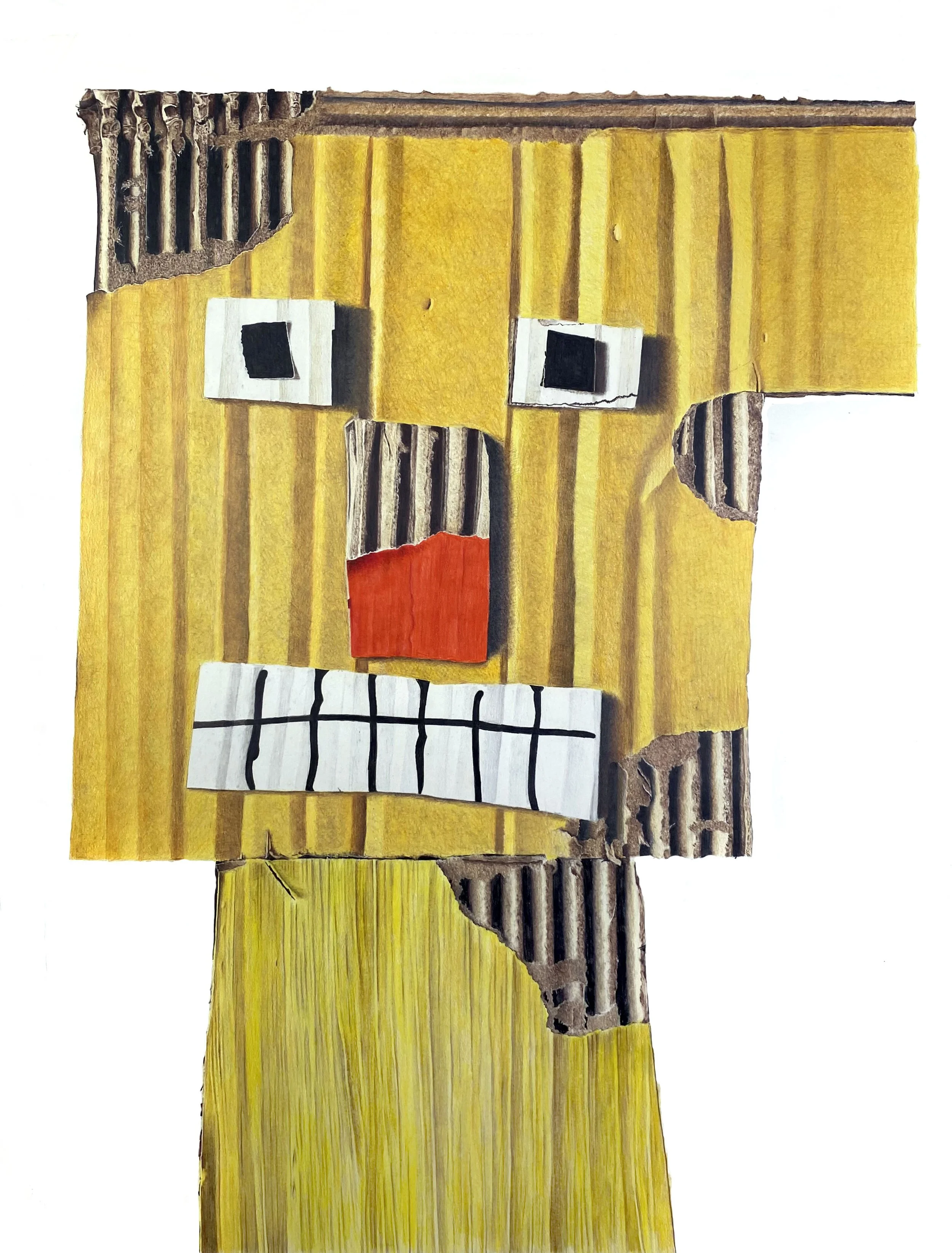
Keesher, pencil on paper, Russel Herron
What are your go-to art materials?
Pencils and paper mostly. I’m not really wedded to particular brands. Erasers and pencil sharpeners. A small comfy bundle of fabric to rest my elbow on. That’s the most essential.
Your portraits aren't portraits of specific people. What interests you about creating faces that feel recognisable but don't actually belong to anyone?
I’m interested in identity and how we construct ourselves, how we present to others and how we understand ourselves. The cardboard portraits allow me to explore identity as something that is quite fragile or ephemeral; something that is knowingly assembled. I think of all the portraits as being part of a self-portrait (reflecting what I have seen in life and then re-presenting). They are things that are in the process of becoming or trying to exist. Or proposing existence.
There’s something quite funny about taking something as ordinary as a discarded cardboard box and treating it as a serious portrait subject.
Do you think there’s an element of humour in the work?
There is certainly an element of humour in the work, but I also think that the portraits speak of a wide range of emotions: these portraits can deal with horror and terror and disgust as much as laughter and surprise and joy. Just like real people.
If your cardboard faces could talk, what do you think they would say?
Who knows? I’m just glad they can’t speak.
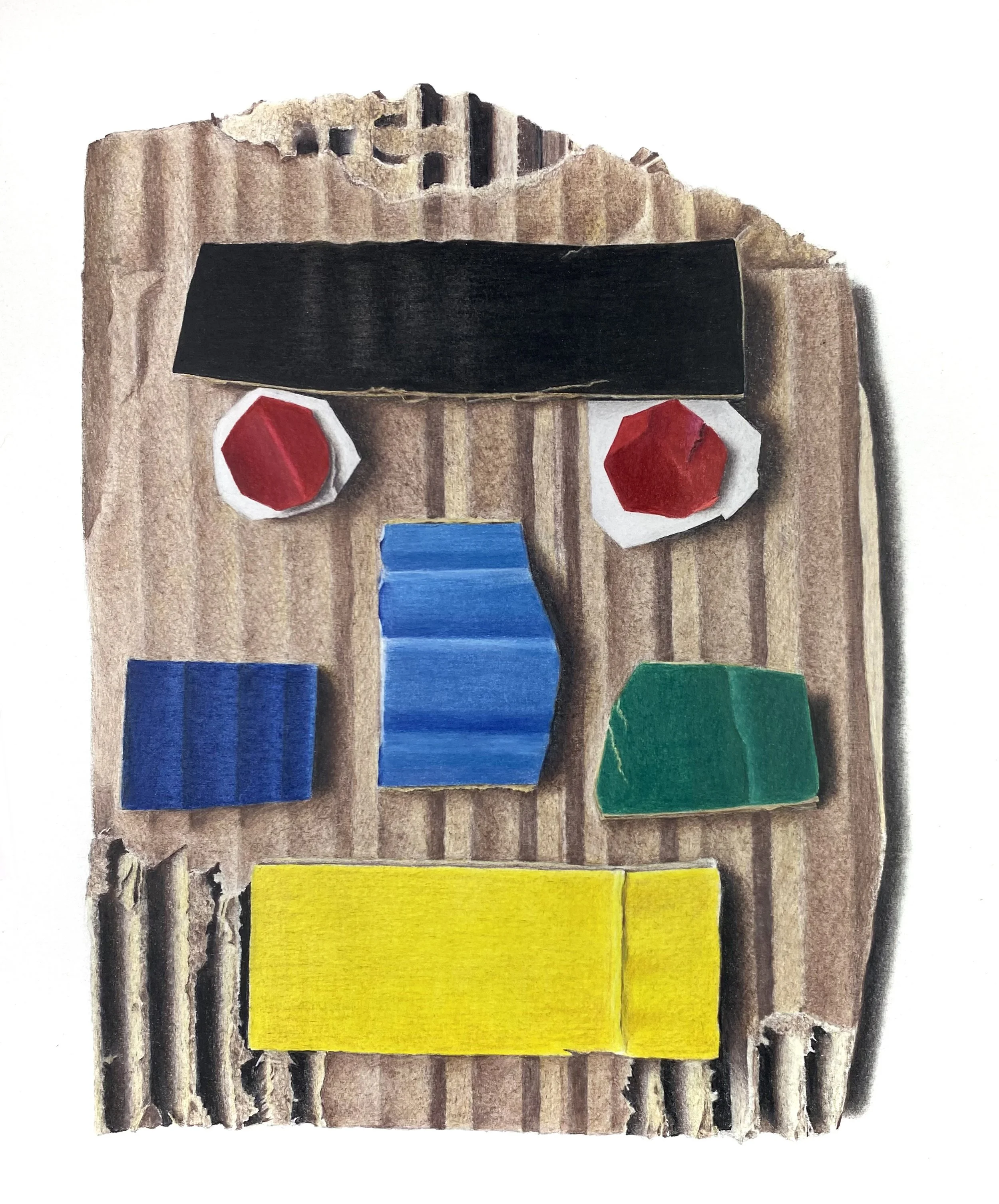
Boy with red eyes, pencil on paper, Russell Herron
What makes a good cardboard face? Is there a particular fold, tear, dent or bit of packaging that immediately gets your attention?
I guess I favour a cardboard that has well defined corrugations that can be exposed. Other than that, I don’t think about it much. I might add in a fold or two. There is a definite sense when the cardboard model feels right and complete (when it successfully resonates with an image in my memory). I have a bad habit of saving bits of cardboard for later projects. I keep them stuffed in a very large cardboard box.
If you had to make a cardboard portrait of one famous person, living or dead, who would it be?
Whoever paid me the most money.
What’s the best piece of packaging you’ve ever received?
Probably something with a birthday present in?

What is faith, pencil on paper, Russell Herron
What would your ideal cardboard find be?
I think all types of cardboard bring their own little idiosyncrasies. Like people do.
What can visitors expect from your exhibition at Green & Stone?
There are many things in this show: drawings, of course, both in colour and black and white, but also pieces of cardboard cast in resin and jesmonite, sculptures in cardboard, postcards, books, merchandise. There’s a lot going on.
What do you hope people notice first when they walk into the exhibition?
Green and Stone have been so supportive, encouraging and helpful with this show and have agreed to so many of the ideas I’ve proposed. Including cladding the gallery in cardboard. I guess people might notice that first. It’ll be like walking into a large cardboard box.

Ungyuun, pencil on paper, Russell Herron
Cardboard faces, Russell Herron’s first solo show at The Gallery at Green & Stone will be on from 22 September - 3 October.