Exhibition Spotlight: Entanglement
Ahead of Emma Rosa and Chloe Farrant’s joint show, Entanglement (May 18 - 30), we sat down with them to talk practice, material, and the influence of the natural world.
In Entanglement, Chloe Farrant and Emma Rosa bring together porcelain, fabric and thread in a quietly arresting exploration of the natural world. Timed to coincide with Chelsea Flower Show, the exhibition pairs Rosa’s exquisitely lifelike botanical textiles with Farrant’s finely observed porcelain sculptures, creating a dialogue between fragility, permanence and the intricate beauty of nature.
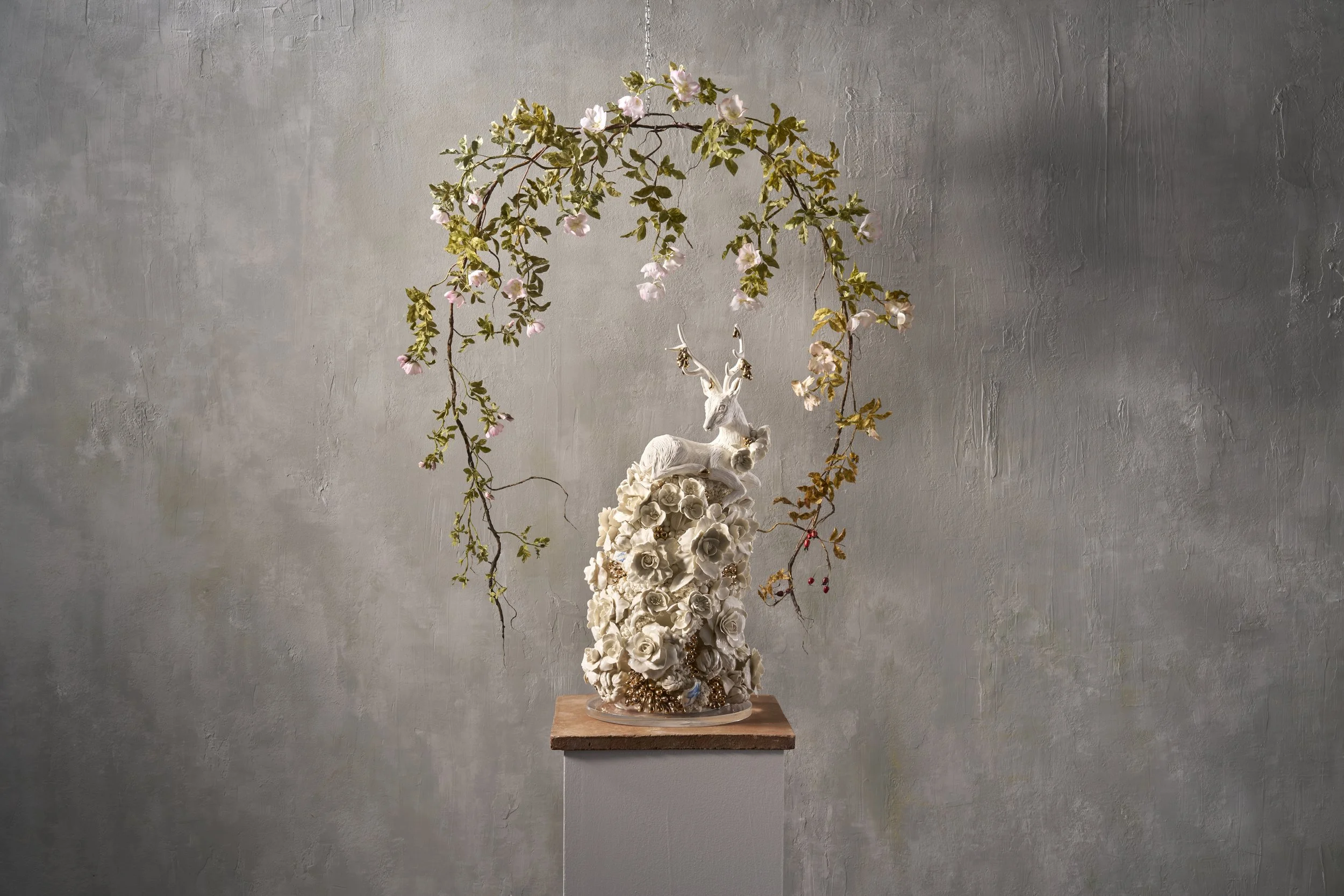
Entanglement will be on view at the gallery from May 18 to May 30.
What do you think first drew you to working in textiles/ clay? Was there a moment where you knew this was your material?
E: Having a past career in fashion, I have worked with textiles for 20 years, so it has been a natural progression to take these materials into art.
C: I was really drawn to clay because it naturally aligns with my process. I like to be quite brave, making bold, physical gestures, and clay allows me to work and rework my ideas, which I find very liberating. The more I worked with porcelain, the more it aligned with what I was trying to say. Its delicacy, its ability to hold fine details, and the way it carries both strength and fragility felt instinctively right.
Can you describe a typical day in your studio?
E: I am lucky to have a beautiful studio at the bottom of my garden, so a short stroll is all it takes in the morning for me to then be submerged in the latest piece that I am working on throughout the day.
C: I have a small studio in the countryside, about a 40-minute drive away, and it feels like complete bliss and an escape from the rest of the world. I have a small dog who sits at my feet while I’m working, and I can easily step out for a short walk to gather inspiration, collecting leaves to imprint into the clay
Do you work from sketches, found imagery, or directly from observation of nature?
E: Ideally I work directly from plant samples, and for my native wild flora in particular, I just need to take a short walk from my house where I am in deepest Devon countryside, where hedgerows, fields and waysides are full to busting with so many species.
I also have a growing collection of antique botanical illustrated books which are particularly useful if I don’t have a real specimen available.
C: My process is quite fluid and tends to move between all three. I often begin with observation by looking closely at plants, animals, and natural forms, but I’m not interested in replicating them exactly. Instead, I take fragments or qualities that resonate and carry those forward.
I use quick sketches as a way of thinking through ideas, but they’re usually loose and exploratory rather than fixed plans.
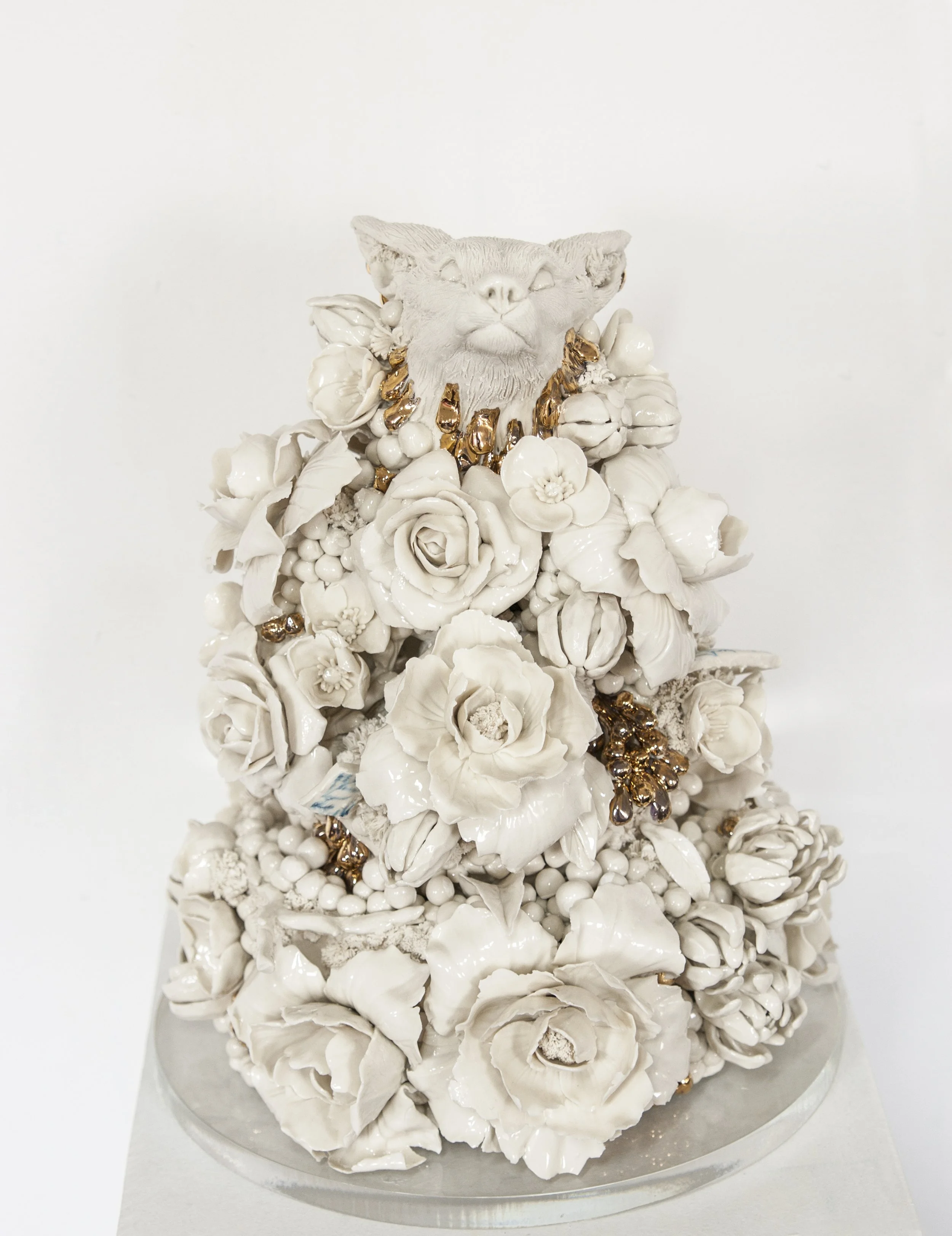
Chloe Farrant, Emergence, Porcelain with glaze and 24k gold lustre, 2026
What role does touch play in your practice, especially given the tactile nature of your materials?
E: My process is extremely tactile by nature of the materials that I use, but the end work itself tends to be untouchable as my work is often set behind glass.
C: Touch is central to my practice. Working with porcelain is a very direct, physical process, and I build each element by hand, so the material holds a record of that interaction.
I’m interested in how something can look soft or alive yet remain fragile and fixed.
In that way, touch becomes both a method of making and an idea within the work giving about connection, presence, and the trace of the human within natural forms.
How does the current environmental climate influence your thinking or making, if at all?
E: So much. I have lived in rural Devon for 7 years now, and it is staggeringly obvious how year on year trends for plants cycles becoming disrupted, which then in turn leads to lower insect population for that year, as plants flowering out of season will mean there is not enough food for when pollinating insects emerge. The changing seasonal weather patterns that occur in the UK now often stress trees and plants, so they will be using energy to cope in survival mode, notable in trees losing leaves early etc. These issues are at the forefront of the story that runs through my work, as I entice a viewer to notice details of flora and engage on a deeper level. Also to turn beauty on its head by asking an audience to look at weeds for the beauty they possess in their own right, and their vital importance in our ecosystem.
C: Although it influences my work, I’m more interested in reconnecting people with nature, giving them a moment to pause and reflect, to see it as something to be treasured and to feel that they are part of it. Environmental concerns sit more in the background, but they are embedded in the material itself. By working with porcelain, a fragile material that holds memory yet is incredibly resilient and strong, I am exploring the strength of nature and how it endures and returns, often with greater force.
How did you two first meet?
E: Chloe runs an amazing extra-curricular art school for children. My daughter attends!
C: That’s how we were first introduced, and we quickly realised we had a shared interest in making and creativity and I loved following Emma’s work and here newest works.
How did this collaboration come about? Was there an immediate sense of shared language between your practices?
E: After knowing Chloe for a couple of years through her art school and knowing her talent for wildlife art, I discovered her porcelain work one day hidden in a back room in her school. I was blown away by the detail and her craftsmanship.
C: It developed naturally through getting to know one another. Emma was planning a show and looking for collaborators, and while I’m mainly known for my street art, I’d also been quietly developing my porcelain work, which she was excited to discover. We immediately felt it would work. There was a real shared language from the start. We’re both drawn to layering, growth, and creating work that feels organic and interconnected, so the collaboration felt like a natural continuation rather than something forced.
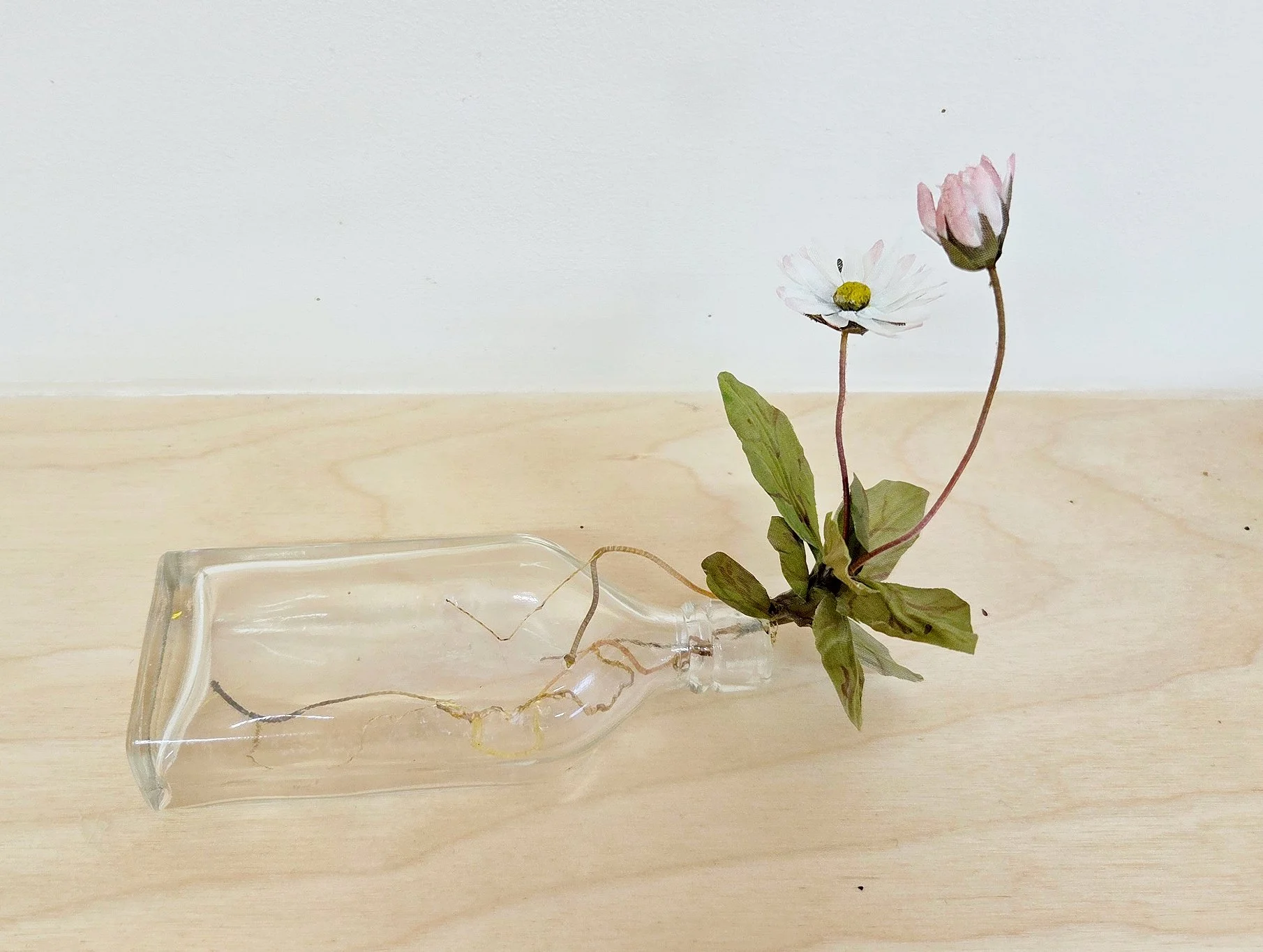
Emma Rosa, Silk, thread and Ink, 2026
Did the collaboration change the way you approached your own material?
E: Yes, it has challenged me in many ways but mostly scale for this collaboration. Working on pieces that had an exchange with Chloe’s sculpture forced me out of my comfort zone and to think big!
C: It gave me more confidence to push my porcelain further as a way of exploring bigger ideas. Emma’s work feels so real and alive, and that encouraged me to really explore the capabilities of my own material. It helped me realize I’m interested in stylizing and form, and in creating a feeling or a piece that opens questions
What do you hope viewers feel physically or emotionally when encountering the work?
E: I hope they come away with a little more knowledge of the floral world, and to notice plant life that they may not have tuned into before. And to look at weeds in a different light!
C: I hope the work creates a moment of pause and brings back that childlike sense of wonder, awe, and hope in the natural world. I also hope it encourages a feeling of connection, both to nature and to something quieter and more reflective within themselves.
What did you learn from each other through this collaboration?
E: We approach work in a similar way to each other which helped massively in the process for this exhibition!
C: I learnt a lot from Emma’s way of thinking, especially through the literature she was reading, which opened a new way of seeing the natural world. It encouraged me to look deeper into what was in front of me, but we actually approach our work in a very similar way, so the whole process felt really fun and natural.
Has Entanglement changed how you think about your future work?
E: Yes. Every piece of work I make usually fires inspiration for the next piece or process.
C: It’s made me think more openly about how my work can grow, especially in terms of scale, layering, and how pieces connect to one another.
Who and What inspires you?
E: Nature itself, The Ware Collection of Blaschka Glass Models of Plants at Harvard University!
C: I’m influenced by designers like William Morris, particularly his use of repetition and motif to create rhythm and flow. I’m also drawn to collage-based practices, and Clare Celeste Börsch’s use of scale and texture. Most of my inspiration comes from nature, especially animals and the constant sense of discovery within it.
You’re going to a Desert Island, what art materials are you bringing with you?
E: My sewing machine, fabric, thread, ink and my Japanese Somebana irons!
C: I’d take clay, a few simple boxwood carving tools and a sketchbook with ink , But I’d probably end up using whatever I could find around me as well.
Entanglement is in the Gallery from 18 May to 30 May.