Botanical Painting with Mariella Baldwin
With the Chelsea Flower Show fast approaching, we sat down with botanical artist Mariella Baldwin to discuss her favourite materials, preferred watercolour palette, and the botanical influences behind her work, as well as her advice for anyone looking to get into botanical painting themselves.
Mariella Baldwin was awarded her M.A. from the University of Sussex following post-graduate studies at West Dean College. Her true passion, however, lies in the portrayal of plants. She studied Botanical Illustration under Anne-Marie Evans at the English Gardening School.
She later became a tutor in the subject, teaching at both the English Gardening School and West Dean College, while also leading workshops at venues including The Wallace Collection, The Eden Project and National Trust, alongside private groups and specialist gardens.
Mariella has exhibited in both the United States and the United Kingdom, with paintings held in private and public collections. She is also a member of the Chelsea Physic Garden Florilegium Society, an organisation documenting the historic plant collection of Chelsea Physic Garden.
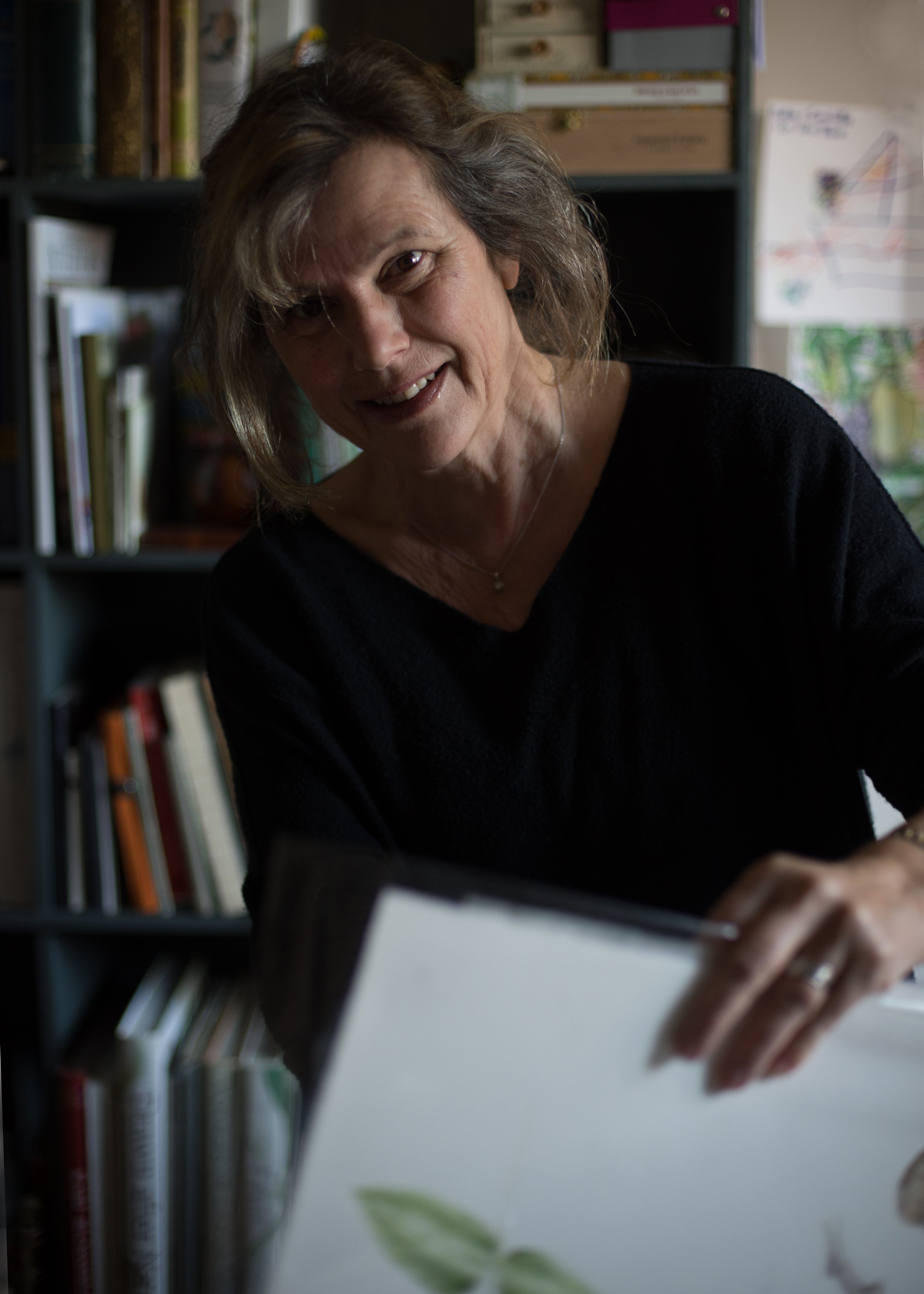
Mariella in her studio, photograph by Christian Doyle
How did you first start botanical painting?
As a 6 year old child my school news book was filled with flower drawings … I seemed to always have something to say about them. Then for A level art I had the most inspiring teacher Gregor Watkins who was so enthusiastic and encouraging with my plant drawings. But I didn’t paint! That came much later in life.
Did you have formal training, or were you mostly self-taught?
I studied for a Diploma in Botanical Illustration at Chelsea Physic Garden under the tuition of Anne-Marie Evans who has been hugely influential in the current explosion in the art form. I then wanted to extend my artistic knowledge and obtained my BA from The University of Creative Arts (aka Farnham Art College) going on to study at West Dean College where I obtained my MA from the University of Sussex in Visual Arts.
What paint do you use?
My watercolour box has had many incarnations as I discover new preparations by watercolour producers (once known as Colourmen). I have been won over by the fabulous paints produced by Michael Harding. They are vibrant and full of luscious gorgeousness. So far I have found that the tubes do not scoot out the medium that has separated from the pigment first. They squeeze out beautifully amalgamated. However, I hate tubes! For me, tubes are a very messy affair. I will be slowly moving from Daniel Smith to Michael Harding having received a gift of Michael Harding colours. They both have superb granulating colours for creating great textures, Schminke are great for smoothness.
I like to squeeze the colours into empty pans - into my watercolour box and then make a colour chart so I know what’s what and what’s where. So often the dark pigments can be difficult to identify when solid. The colours will dry and can be used just like traditional half pans. Botanical artists working at life size tend to use very small amounts of paint so making use of a watercolour pan is an economical way to proceed.
Do you have a favourite flower or plant to paint?
I am obsessed with all plants but I am drawn to the unsung and particularly vegetables, sometimes something just calls out to me … and off I go. I tend to like a muted palette. I do like painting an Iris.
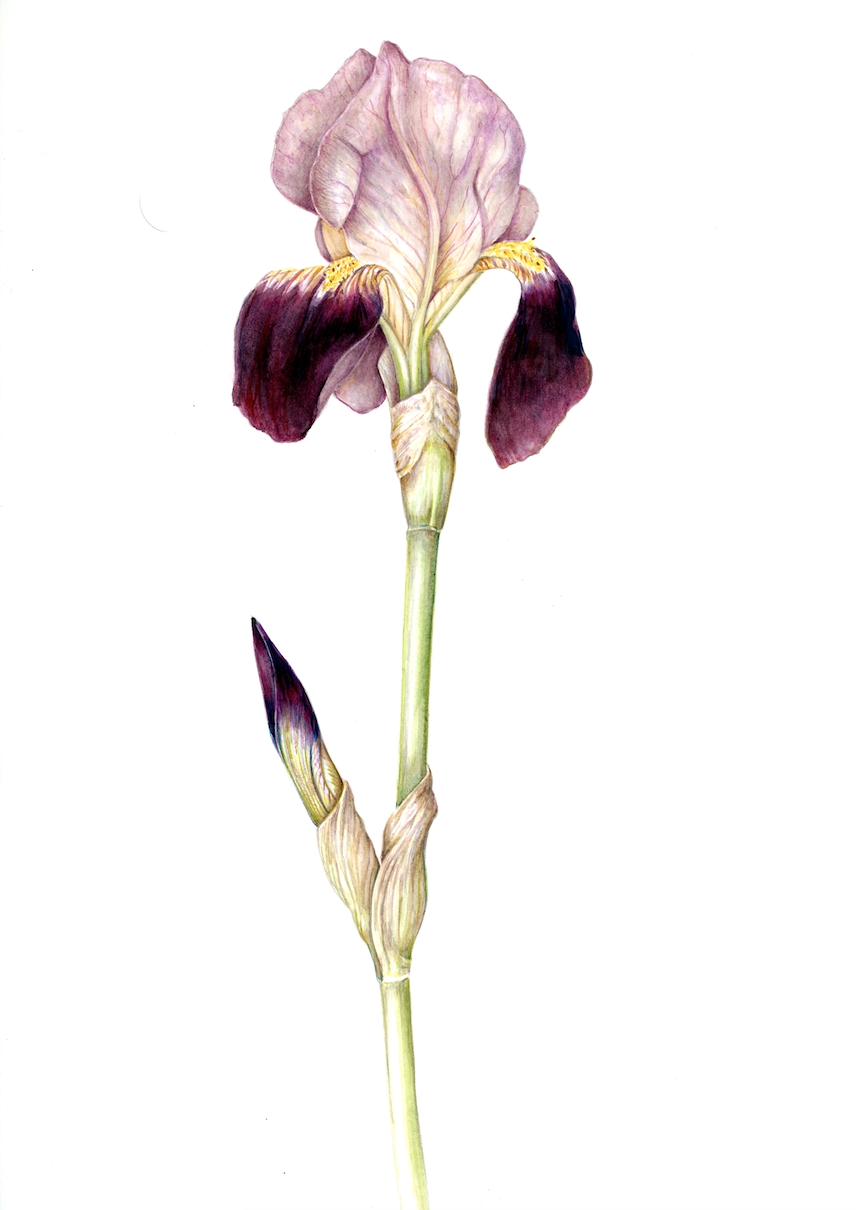
Flag Iris for Aldingbourne, Mariella Baldwin
Describe your colour palette…
I like to keep things simple and I tend to begin with a limited palette. For plant subjects I find Lemon Yellow, Ultramarine Blue and Quinacridone Rose is a good way to begin - it is possible to mix a good Orange, Red, Violet and Green and of course a wonderful array of neutrals, including Black with just these three. I then begin to dip into a wider palette for accurate colour matching. It can be hard to resist extra colours (it’s like being in a sweetie shop!) And being unable to resist I have many more paints that I love dipping into … enjoy your own personal adventure.
I use Michael Harding colours, Lemon Yellow, Hansa Yellow Medium, Ultramarine Blue, Cobalt Blue, Quinacridone Rose, Pyrrole Red, Phthalocyanine Green Lake, Deep Purple (Dioxazine) Raw Umber, Burnt Sienna, Quinacridone Gold and Ochre Havana of France and then a few lovelies I add: Sepia, Green Gold, Idanthrone Blue, Permanent Alizarin Crimson, Terre Verte, Perylene Magenta, with no preference for make. I also love Schminke Violet, Schminke paints are also superb - they are creamy and flow well.
What art materials would you recommend for a beginner Botanical artist?
I like Faber Castell 2H or HB Pencils. I use a Pentel Mechanical pencil with 0.3 lead. I also do like Blackwing pencils. A good pencil sharpener or craft knife is essential. I use fine grade sandpaper 0000 for sharpening tips of wooden or clutch pencils. I would recommend buying the purpose made mechanical pencil sharpener.
I use the Green & Stone smooth cartridge paper pads in A4 and also Daler Rowney A4 Tracing Paper.
Arches Hot Pressed watercolour paper is the best, and I also use Saunders Bockingford Hot Pressed. These pads don’t come in metric sizes, so choose what you approximately want - ie approx A4 or A3 for example. I like using pads as the paper is stretched and less prone to damage. They are more expensive but are worth it.
I use scrap paper for a hand guard, a clean cotton rag, or kitchen towel, blotting paper. I would recommend using a 20cm ruler or a triangular set square.
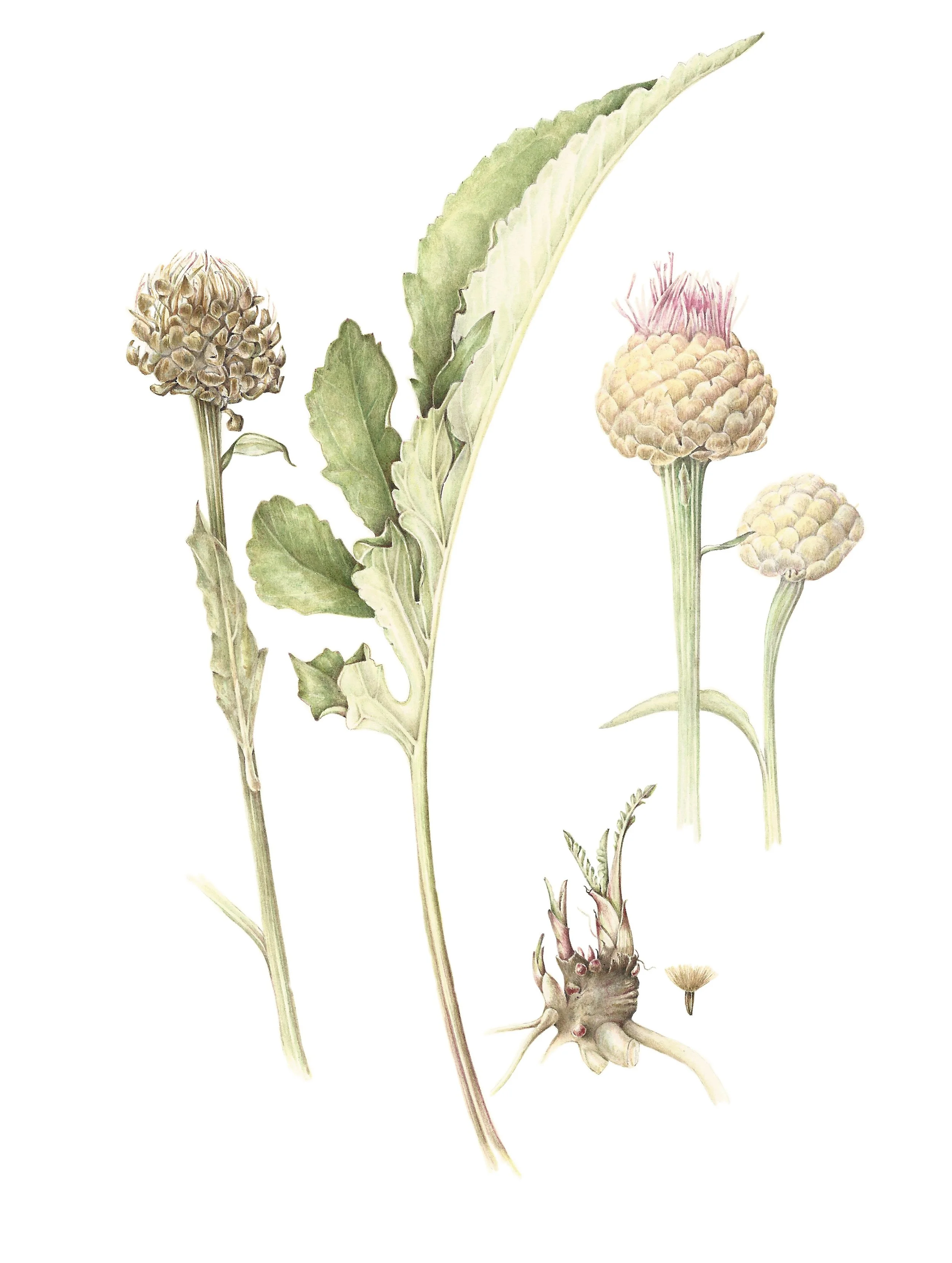
Leutzia Centauroides, Mariella Baldwin
What are your favourite brushes and what would you recommend to students?
I like Kolinsky Sable watercolour brushes, Da Vinci, Winsor & Newton, the Isabey miniature brushes in size 2 & 4, or an equivalent ‘spotter’ and a regular Sable watercolour brush. Synthetic brushes can be used so long as they have a good tip so as to get a sharp point. I find that synthetic brushes tend to wear out faster and unevenly so are not as economical as they may first appear. The joy of physical art shops is that you can check the point of your brush in the store. I also use a Pentel Aquash water brush in size medium.
What does a typical botanical painting process look like for you from start to finish?
I begin with loose sketches in my sketchbook, looking at a plant from every angle. I then start drawing with very light guidelines, to help keep the drawing in check, creating a skeleton. I then begin to flesh the drawing out. Placement on the page is so important - and I try out thumbnails in my sketchbook, before committing to the Hot pressed watercolour paper. Hot pressed paper has the ability to take numerous successive washes that allows the paint to positively glow.
Slowly, slowly I build up colour, layering washes rather than necessarily mixing the ‘correct’ colour in my palette. I make use of directional light from the top left to aid the visualisation of tone which is vital to creating a 3D image of a plant that looks as if it could be plucked from the page. It is important to have a full range of tones within the painting from the very light to the very dark. The lightest areas maybe unpainted; the paper will be your pure white. I like to make use of aerial perspective, fading parts of the plant that are in the background.
The hardest part is to know when one has finished. It can be easy to overwork a painting and then can look too stiff and posed. Therefore I like to walk away and leave it overnight to reassess. Sometimes I will have two or even three paintings on the go simultaneously to help prevent overworking.
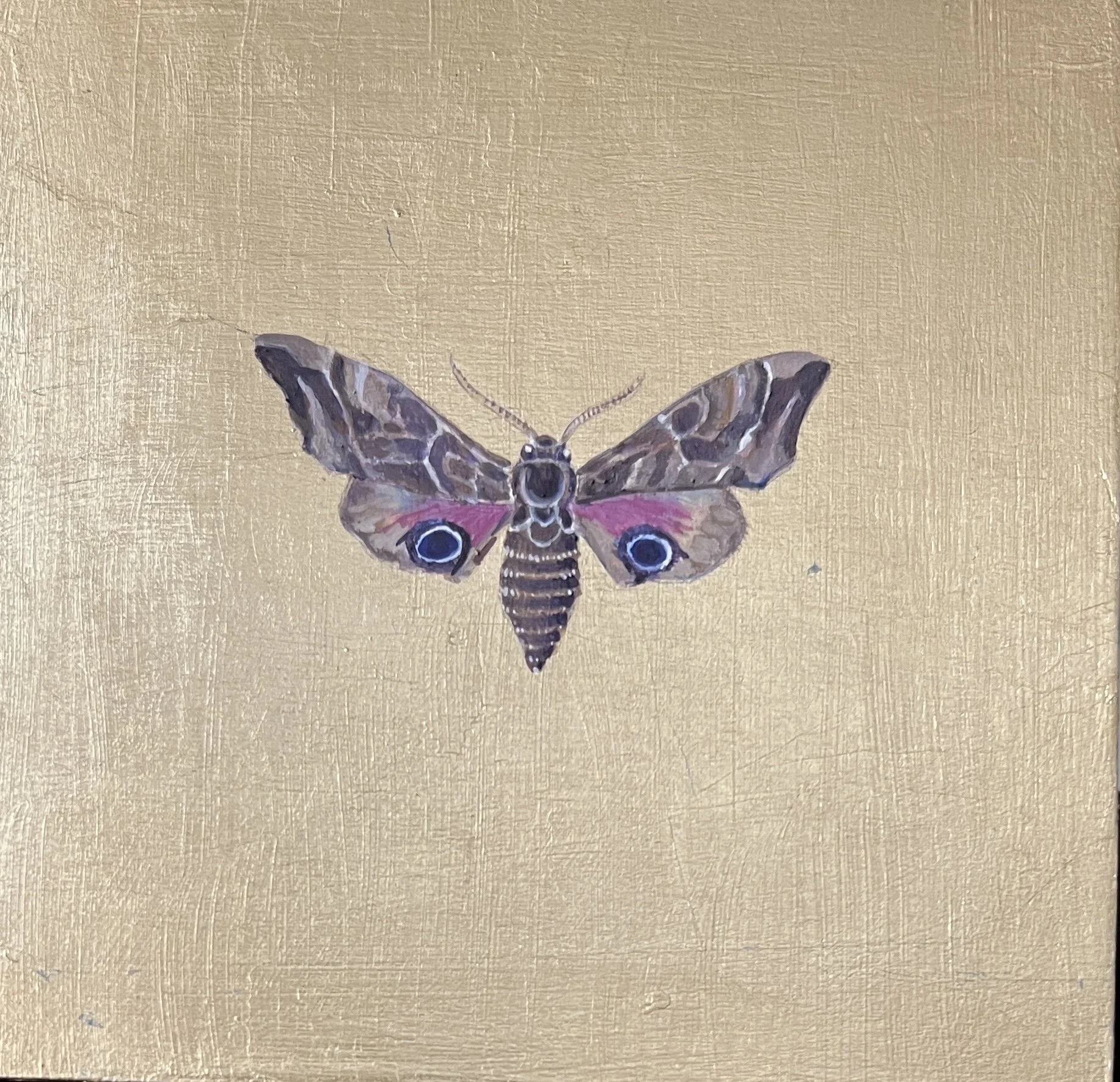
Eyed Hawk Moth, Mariella Baldwin
What’s the hardest part of botanical painting to master?
From experience I think it is the successful manipulation of watercolour paint. Understanding the properties of the pigments, the ratios of pigment to water and the control of paintbrushes. … and then giving up too early. Strong contrasts have the biggest impact and it is easy to bottle out before these have been achieved. It is not meant to be easy … persevere! I have a book for my colour notes - it can be hard to remember what mixes were used in a painting as I rarely complete a painting in one setting.
This quote describes it perfectly; ‘Even if the painting is burnt the next day, even if you later put a knife through it I think that it is important to make it as perfectly and thoroughly as one can, because it’s a gesture, a votive something, so it must be done for its own sake as something in itself.’ Bridget Riley
Do you work from life, photographs, or pressed specimens?
I work from life, frequently making use of new fresh material for as long as it is available. It is important to keep the plant, as well as yourself well refreshed. Putting a plant in the fridge can help keep it in suspended animation, or in a plastic box on damp kitchen towel in the fridge (with a large sign saying ‘Do not eat!’) Photographs are useful for reference but the colour matching can be unreliable - converting the image to black and white can be useful to see the tone as colour often distracts - and pressed specimens in extremis!
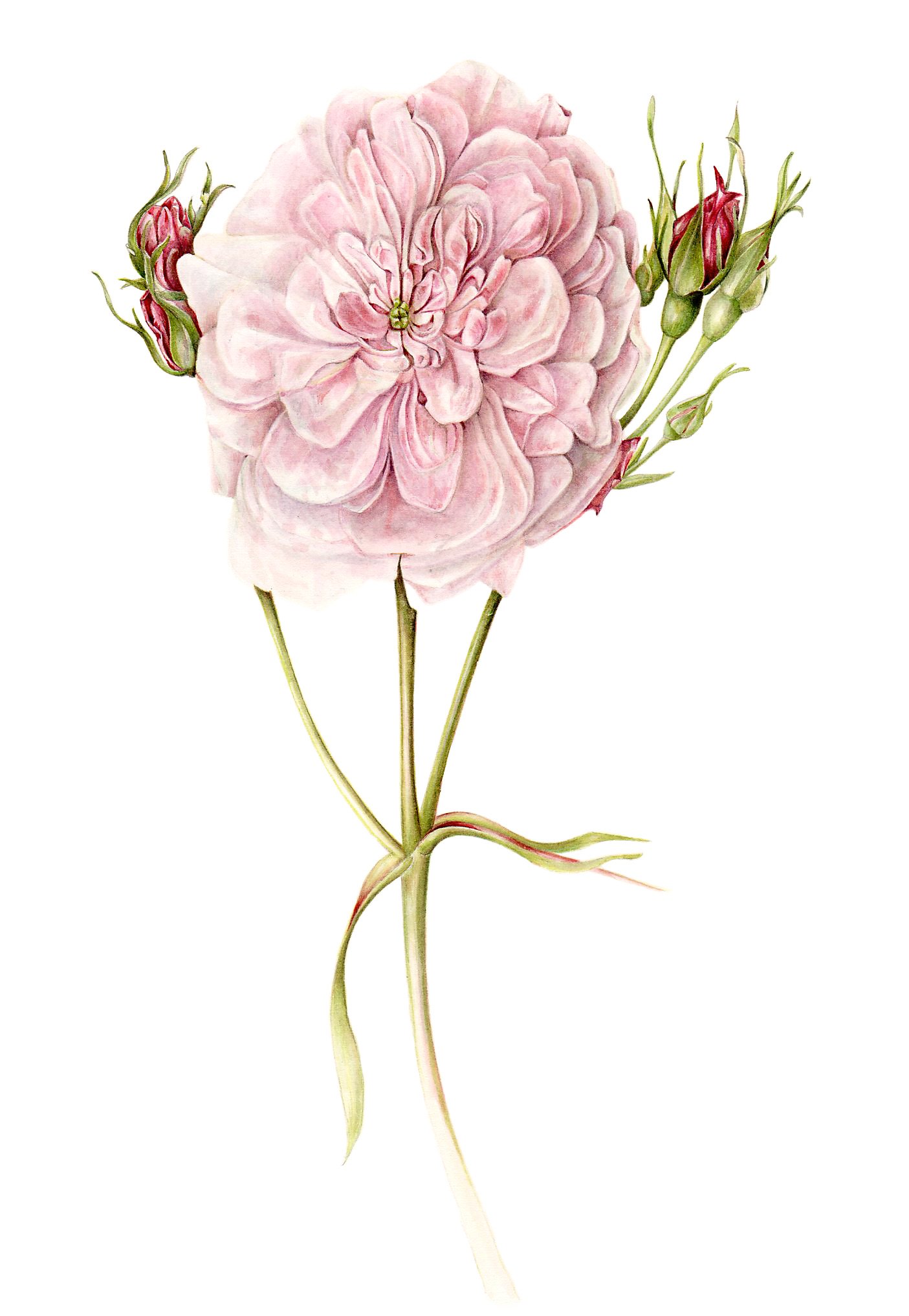
Pink Rose on White, Mariella Baldwin
Why do you think botanical art still resonates today in such a digital world?
I think this quote is quite apposite:
‘Despite the illusion of giving understanding, what seeing through photographs really invites is an acquisitive relation to the world that nourishes aesthetic awareness and promotes emotional detachment’ - Susan Sontag, 1973
My MA dissertation explored this subject referring to drawing in a digital age. Many of us are drawn to the beauty of plants and indeed we rely on them for our survival. I believe the more one looks and understands the greater the interest becomes. Flowers on the whole are seasonal and ephemeral so to commit them to paper is a way of preserving their beauty. Of course a photograph can do this with one click. I believe whilst the digital image and all it offers for artistic impression is magnificent, it can become mere eye candy - especially as we are relentlessly bombarded with images minute by minute.
Botanical art is slow and tactile. It can be meditative, and demands concentration that has the ability to shut out the background noise of life.
‘The tactile connects us with time and tradition; through impressions of touch we shake hands with countless generations’. - Juhani Pallasmaa
Botanical art has been within our psyche for as long as we have been documenting our existence - it can be a way of saying ‘I was here and this is what I saw’.
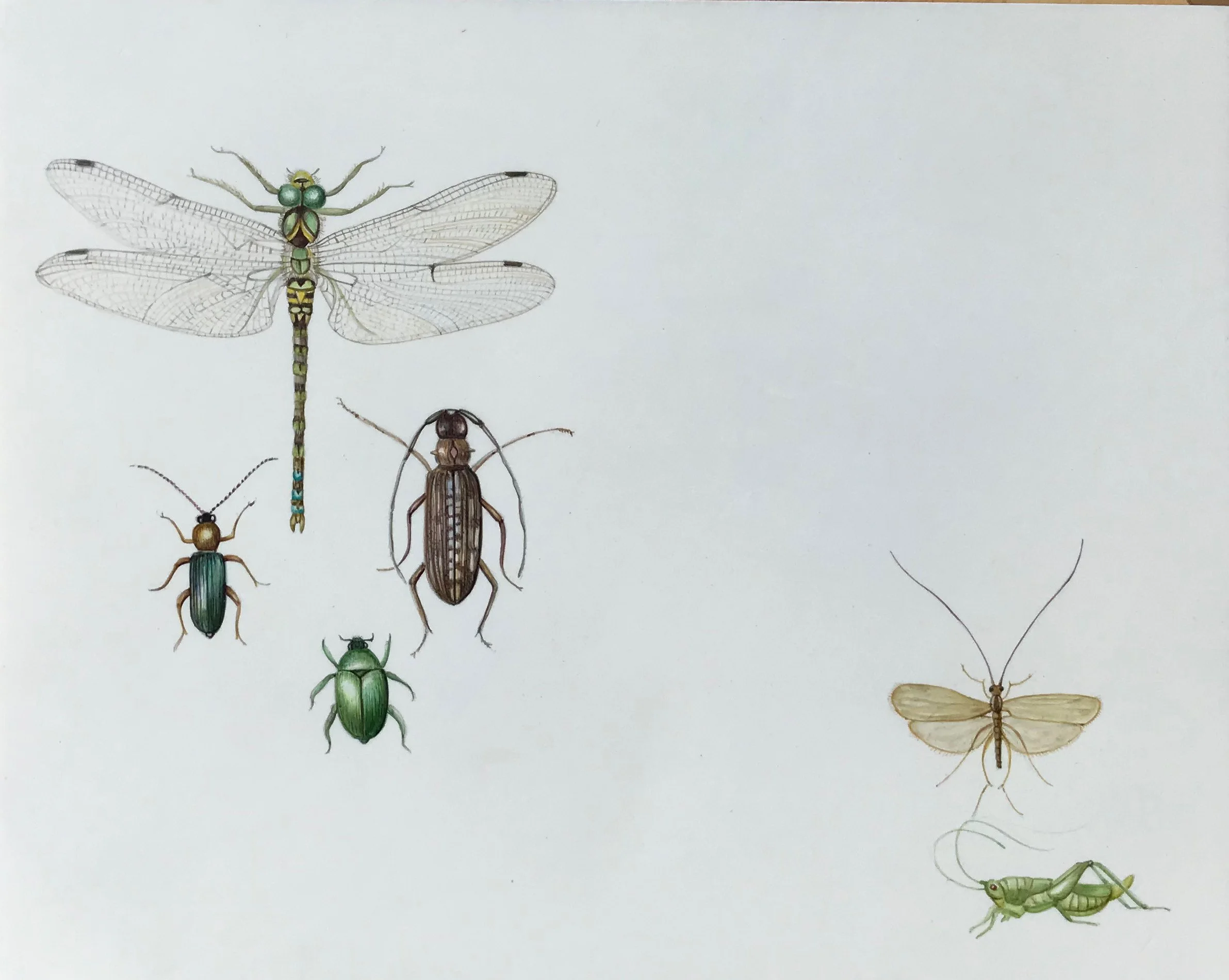
Insects on vellum, Mariella Baldwin
Who and What inspires you? Who are your favourite artists?
The very first botanical artists I became aware of were Olivia Anne Dowden an American botanical artist (1907-2007), Robin Tanner, (1904-1988) a British artist who illustrated the garden catalogues for John Scott and Co, Merriott, Somerset in the 1960’s, and inevitably, the Belgian master of botanical artist Pierre Joseph Redouté, for A Level. Once at Chelsea Physic Garden my eyes were opened to so many other botanical artists including French artist Nicolas Robert (1614-1685) and Scottish artist Rory McEwen (1932-1982).
I am inspired by so many artists in all media, from drawing, etching, painting in all mediums and photography my list would be too boring. If I had to select a random few botanical artists who I admire at the moment: Martin Allen, Regine Hagedorn, Mary-Ellen Taylor, Elaine Searle, Fiona Strickland - and from the ancients, my insects Jan van Kessel and flowers Henri-Fantin Latour, and Piet Mondrian.
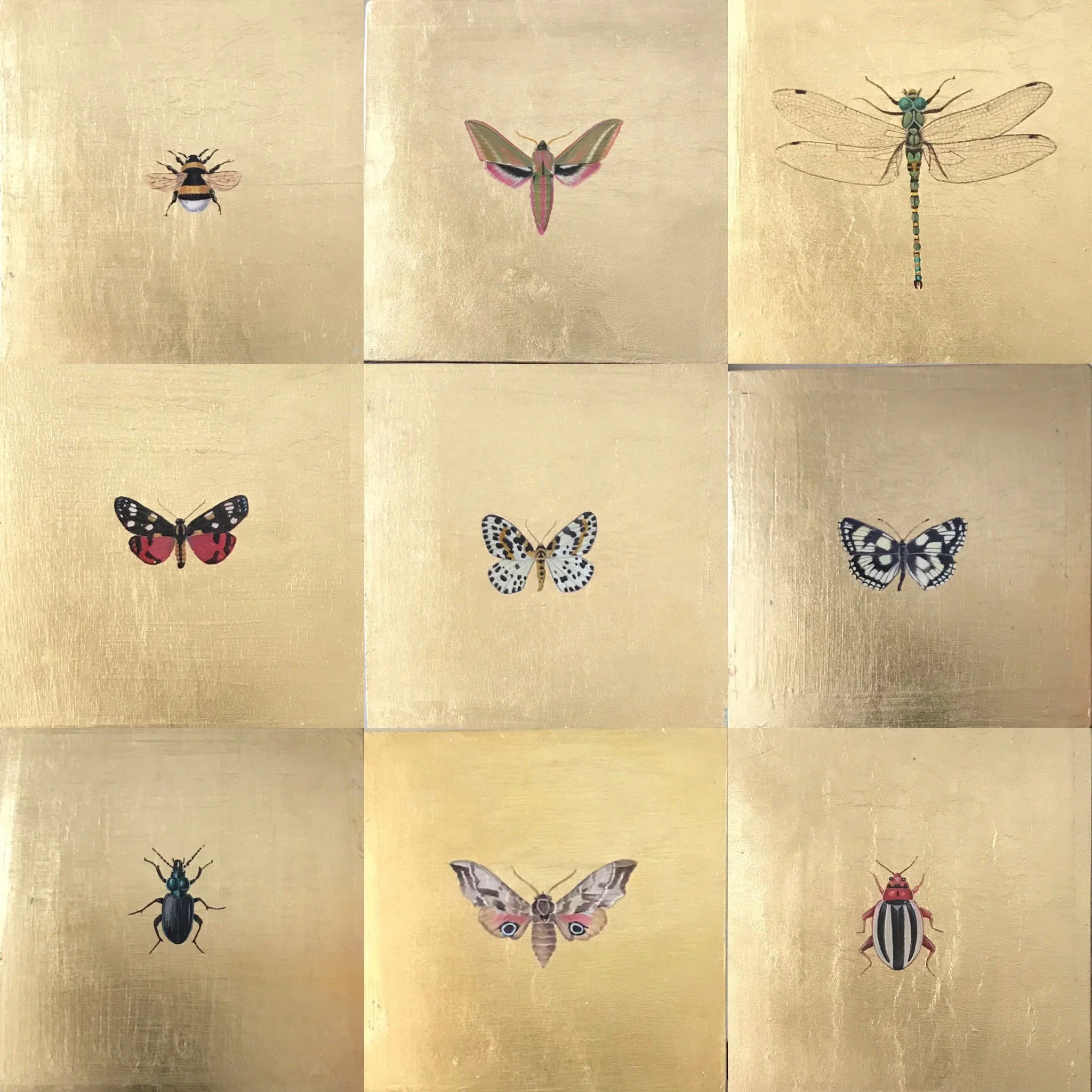
Golden Insects, Mariella Baldwin
Finally, what advice would you give to someone trying to start botanical painting?
Get a sketchbook with very smooth paper. An inexpensive school type book would be fine, a sharp 2H or HB pencil and just begin. Take a flower apart to understand it and then just go for it. Leave your sketchbook and pencil out on your kitchen table and spend just 5 minutes a day - observing and drawing.
Don’t begin on the first page! Randomly select a page within the book and start there. The pressure to produce a masterpiece on page one is just too scary … Examine past and present artists who have studied plants in their practice for inspiration.
The Shirley Sherwood Collection is an excellent place to start. Shirley Sherwood has a wonderful eye and her collection homes the very best of botanical art.
I can give one bit of advice if you have limited funds, begin with a limited palette and explore it to its limits. I would suggest Lemon Yellow, Ultramarine Blue, Quinacridone Rose. A white china palette, or plate is essential, you can use this like a watercolour box. Green and Stone sell lovely little white ceramic palettes.
If you are interested in seeing more of Mariella’s beautiful work please head to her website and instagram to check it out!