How to Write an Artist Statement (Without Losing Your Mind)
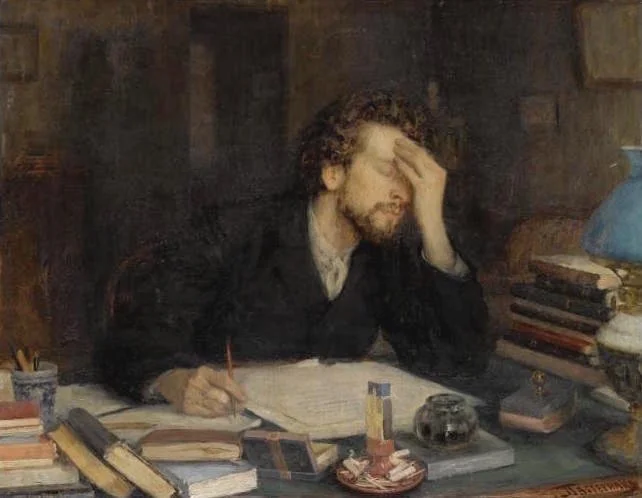
Leonid Pasternak, The Passion of Creation
What We Want to Know: Writing Your Artist Statement
Are you afraid of sentences?
Do you break into a cold sweat at the words “artist statement”?
Have you ever opened a blank document, stared into it, and thought, absolutely not?
If you answered “Yes!” Congratulations. You are an artist.
But alas! The world insists. Applications must be filled out. Websites must be written. Curious viewers must be gently guided away from confusion and towards understanding. And so, we encourage you to write about yourself.
Fear not. We have advice!
What is this dreaded object?
An artist statement is not a poem. (It may feel like one, but resist.)
It is not a biography. (No one needs to know where you went to school just yet.)
It is, quite simply, what you make, why you make it, and how it comes into being.
That’s it. Nothing more mystical than that. No incense required.
What do we actually want to know?
Imagine a poor, unsuspecting viewer. They stand before your work. They tilt their head. They squint. They lean in. They step back. They whisper to their friend:
“What is going on here?”
This is where your statement enters, stage left.
We (the viewer, the curator, the collector, the mildly confused aunt) want to know:
What is this work about?
Why do you keep returning to this thing?
What have you made it with? (Be honest, is it oil, dust, grief?)
Where should we look?
You are not explaining everything. You are simply turning on a light.
A note on language (or: put the thesaurus down)
There is a peculiar disease in the art world. It causes otherwise sensible people to write sentences such as: “I interrogate liminal spatialities through a destabilised visual syntax.”
No, you don’t. Well, you might, but please don’t say it like that.
Instead: “I paint figures at the edge of forests to explore moments of uncertainty.”
Ah! We see! We understand! We nod approvingly!
Clarity is not the enemy of intelligence. In fact, it is often a sign of it.
Write like a person
A good test:
Would you say this out loud to someone standing next to your work?
If the answer is no, rewrite it.
If you wouldn’t say “my practice navigates ontological thresholds” in real life, then banish it from the page at once.
You are allowed to sound like yourself. In fact, it is strongly encouraged.
A simple formula (no alchemy required)
If you find yourself spiralling, cling to this:
What do you make?
What ideas are you circling?
How do you make it?
What holds it all together?
There. A statement is born.
Keep it short. 100–200 words. No epics. This is not War and Peace.
Editing (the quiet brutality)
Now take your beautiful paragraph and begin the gentle destruction:
Cut repetition
Remove fluff
Shorten sentences
Replace vague words with real ones
If a word does not earn its place, out it goes.
Be ruthless. Be elegant. Be brief.
Common sins (we have all committed them)
Writing in the third person (“She explores…”) — who is she? Are you not present?
Explaining every possible meaning — leave something for us!
Using language you would never, ever say aloud
Writing far too much
Avoiding the task entirely (tempting, but ineffective)
Final encouragement
A good artist statement does not perform tricks. It does not dazzle. It does not obscure. It simply helps us see. Your work is already doing the heavy lifting. The statement is just there to nudge us in the right direction.
Now go on. Open the document. Write the first sentence. No drama.
Well… perhaps a little.